

8 Motor Coach Rental Facts for Long-Distance Groups
Long-distance group travel gets easier when you treat motor coach rental as a logistics decision, not just a vehicle choice. NY Limo Bus Inc., a Tri-State ground transportation company that offers charter buses, limo buses, vans, and other group vehicles, sits in a category where trip legality, baggage planning, and route design often matter more than raw seat count.
TL;DR: Summary
- For long-distance groups, motor coach rental works best when you plan around FMCSA driver-hour limits, route timing, and baggage capacity, not just the number of seats.
- FMCSA rules limit passenger-carrying CMV drivers to 10 hours of driving after 8 consecutive hours off duty and no driving after 15 hours on duty, which can change same-day and overnight itineraries.
- The Bureau of Transportation Statistics says the Intercity Bus Atlas tracks about 3,500 stops and 1,800 routes, but scheduled intercity service is different from private charter flexibility.
- American Bus Association data shows a large but fragmented market: 1,984 carriers and 47,946 motorcoaches in 2023, with about 90.0% of companies providing charter service.
- If you are comparing operators, including providers like NY Limo Bus Inc., check relief-driver needs, luggage fit, overnight timing, parking, tolls, and multi-day trip assumptions before you judge price.
A good rental decision usually comes down to four questions: Is the vehicle actually a motorcoach, can the trip run legally, will luggage fit, and does the quote reflect the real route? Those are the facts that keep school groups, corporate teams, sports travelers, and event planners from paying for the wrong setup.
What counts as a motorcoach rental in the United States?
A motorcoach is a specific bus type, not a catchall label. FMCSA defines a motorcoach as a bus with an elevated passenger deck over a baggage compartment, which makes underfloor storage a core part of the category.
That definition matters because many travelers use terms like charter bus, shuttle bus, and party bus or limo bus as if they mean the same thing. They do not. A charter bus describes the service model, meaning the vehicle is booked privately by a group. A motorcoach describes the vehicle design, especially the elevated seating deck and baggage bay that support longer highway trips.
A common mistake is assuming that any large bus with similar seat count is functionally equal. For a 200-mile airport transfer, that may be close enough. For a multi-state run with full-size luggage, instruments, trade show materials, or sports gear, the baggage compartment becomes one of the most important decision points.
“NY Limo Bus Inc. says it was founded in 2008 and provides charter buses along with sedans, vans, stretch limousines, limo buses, and party buses.”
If your group needs long-haul comfort and real luggage capacity, the motorcoach layout is often the better fit. If your trip is short, social, or baggage-light, another vehicle class may still be the smarter choice.
Why do driver hour rules change long-distance motorcoach planning?
Driver-hour limits directly shape motorcoach schedules. Under FMCSA rules, a passenger-carrying CMV driver may not drive more than 10 hours after 8 consecutive hours off duty and may not drive after 15 hours on duty.
That means a trip that looks easy on a map can fail in practice once traffic, meal stops, boarding time, and venue delays are added. The 10-hour driving cap is not the same as a 10-hour travel day. On-duty time includes more than the moving portion of the route.
This is where groups often misjudge “nonstop” travel. A routine rest break does not automatically create off-duty time. FMCSA guidance says the driver must be relieved of responsibility for passengers, baggage, and freight before that time counts as off duty. If the schedule requires straight-through travel beyond one driver’s legal window, a relief driver may be needed.
If your itinerary is close to the limit, then even a modest delay can force a new stop plan or an overnight adjustment. That is why the safest quotes tend to look more detailed, not less.
What are the 8 motor coach rental facts that matter most for long-distance groups?
The most important facts are operational, legal, and practical. They affect whether the trip can run on time, at the quoted price, and with the right vehicle class.
- A motorcoach is not just any bus: FMCSA ties the term to an elevated passenger deck over a baggage compartment.
- Driver time is capped: Passenger-carrying CMV drivers may drive no more than 10 hours after 8 consecutive hours off duty.
- Duty time is also capped: Drivers may not drive after 15 hours on duty, even if actual wheel time is lower.
- Straight-through service may require a relief driver: That can change cost and scheduling on long interstate trips.
- The market is large but fragmented: The American Bus Association reports 1,984 carriers and 47,946 motorcoaches in the United States and Canada in 2023.
- Most operators do charter work: About 90.0% of motorcoach companies provided charter service in 2023.
- Route data matters: The Bureau of Transportation Statistics says the Intercity Bus Atlas includes about 3,500 stops from 1,800 routes.
- Baggage planning beats seat counting: Groups with full-size luggage, uniforms, or event materials can outgrow a vehicle before they run out of seats.
Taken together, these facts point to one rule: book the trip around operating reality, then match the vehicle.
How should you build a legal long-distance itinerary?
A legal itinerary starts with driver limits and route math. For operators like NY Limo Bus Inc. that serve interstate group travel in the Tri-State area, timing the day around FMCSA rules is the first filter, not the last.
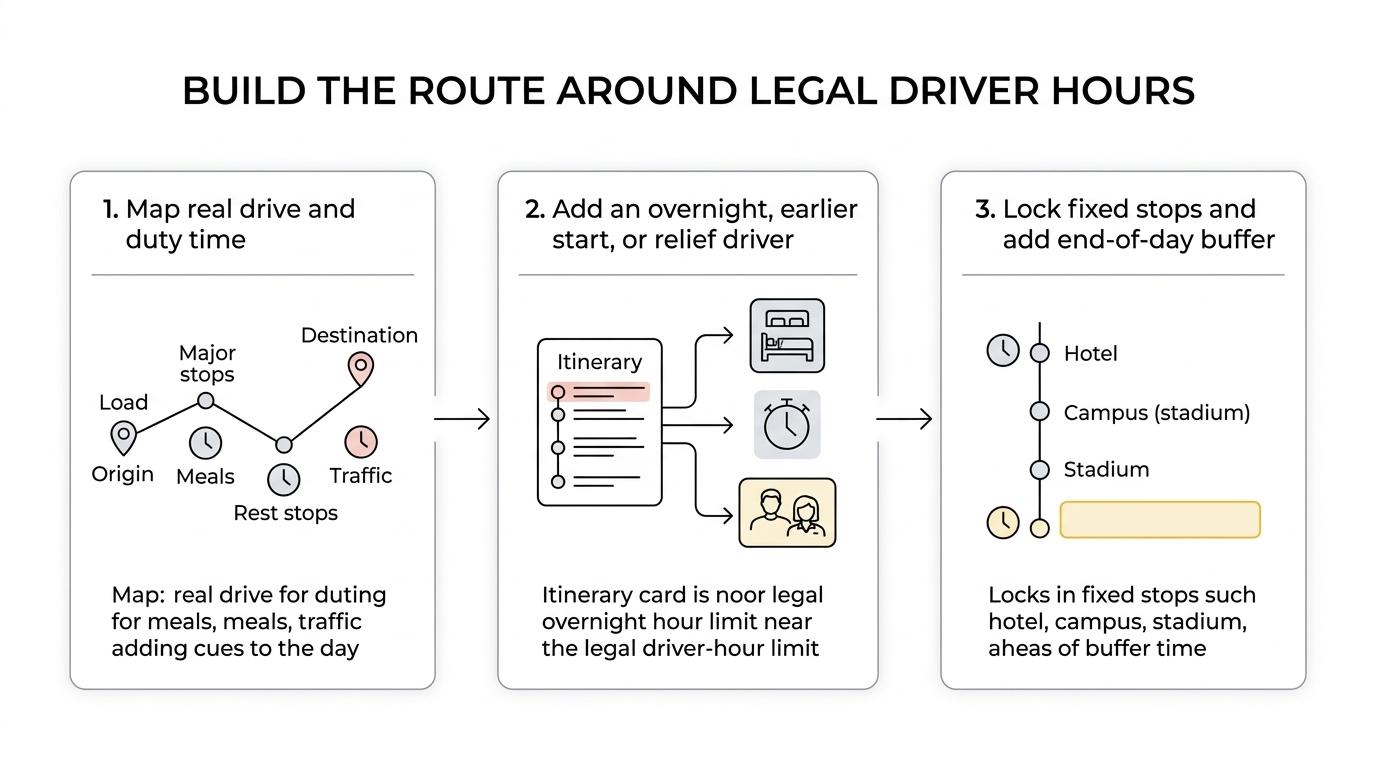
Step 1 is mapping real drive time between every major stop, not just origin and destination. Add pickup loading, rest stops, meals, venue access, and urban congestion. If the total approaches the 10-hour driving threshold or the 15-hour on-duty window, then the plan needs revision.
Step 2 is deciding whether the group can accept an overnight stop, an earlier departure, or a second driver. If the answer is no, then you need to confirm whether a relief-driver setup is even available for that route. That is often the turning point between a feasible trip and an attractive but unrealistic quote.
Step 3 is locking timing around the least flexible segments. Hotels, campuses, cruise terminals, and stadiums can be less forgiving than highway travel itself. Pro tip: build buffer time at the end of the day, not just at departure. Delays compound late in the schedule.
How is a motorcoach different from a charter bus, party bus, or limo bus?
A motorcoach is usually the best fit for highway mileage and luggage. A charter bus is the booking model, while a party bus or limo bus is typically designed more for social atmosphere than underfloor storage.
This is where terminology causes expensive confusion. A company can provide charter service using different vehicle types. So “charter bus” does not automatically mean “motorcoach.” You still need to ask what body style, storage layout, and trip profile the operator is quoting.
A simple way to separate the terms helps:
- Motorcoach
- Charter service
- Party bus or limo bus
In practice, a motorcoach is optimized for distance, seated travel, and baggage. A party bus or limo bus often prioritizes interior social space, lighting, and event ambiance. That can be great for weddings, proms, and city nights out, but less ideal for a multi-day interstate itinerary with large suitcases.
How do you estimate baggage and onboard space before booking?
Baggage planning should start before you compare prices. Suitcases, uniforms, instruments, coolers, and presentation materials can change the correct vehicle more than passenger count does.
The fastest way to avoid trouble is to classify what each traveler brings. A 40-person group with backpacks is very different from a 40-person group with checked luggage and equipment cases. If the trip includes airport legs, assume fuller bags than you would for a day excursion.
Use a simple planning frame:
- Passengers: headcount plus expected no-show margin
- Checked bags: full-size suitcases, duffels, garment bags
- Special items: instruments, medical gear, sports equipment, boxes
- Cabin needs: carry-ons, snacks, documents, onboard essentials
A common misconception is that “one bag per person” is enough detail. It is not. One roller bag and one hockey bag do not consume space the same way. If your luggage profile is unclear, then the quote should stay provisional until it is clarified.
Is the motorcoach market dominated by a few giant companies?
No, the market is large but fragmented. American Bus Association research shows 1,984 carriers operating 47,946 motorcoaches in 2023, which means buyers often choose among many regional and midsize operators rather than a tiny national handful.
That fragmentation changes how you compare options. A larger operator may offer broader coverage or deeper dispatch capacity. A regional operator may offer better local timing, more direct routing knowledge, or a fleet mix that fits the trip more closely. Size alone does not tell you whether the service plan is better.
“NY Limo Bus Inc. says it serves New York, New Jersey, Connecticut, and Pennsylvania, a reminder that many group trips are handled by regional operators rather than national networks.”
Another useful ABA data point is that about 90.0% of motorcoach companies provided charter service in 2023. So charter access is common, but quality still depends on vehicle fit, scheduling discipline, and trip design.
How do scheduled intercity routes affect private group travel?
Scheduled intercity service is useful context, but it is not the same as private charter planning. The Bureau of Transportation Statistics says the Intercity Bus Atlas now tracks about 3,500 stops from 1,800 routes and updates the map quarterly.
That matters because it gives planners a public snapshot of where scheduled intercity passenger bus services are strong, thin, or absent. If a city pair has many scheduled links, then you know the corridor is active. If service is sparse, then private charter may be the only practical group option.
Still, do not confuse scheduled-route density with charter flexibility. Scheduled carriers work on fixed stops and published timetables. Private motorcoach rentals work on your pickup point, your destination sequence, and your event timing. Those are different products, even when they run in the same corridor.
A smart use of the Atlas is as a planning reference, not a substitute for a charter itinerary. It helps you gauge network maturity and backup options, especially for multi-city travel.
How should you compare motorcoach rental quotes for multi-day travel?
The best quote is the one that matches the real trip. When NY Limo Bus Inc. or any other operator prices a multi-day motor coach rental, the useful comparison is scope versus assumptions, not just total dollars.
Start by checking whether each quote covers the same itinerary, hours, mileage, and vehicle type. If one quote assumes a tighter schedule or a different luggage profile, then it may only look cheaper on paper. This is where many group organizers accidentally compare unlike offers.
Focus on the variables that change cost and feasibility:
- Driver setup: single driver, relief driver, overnight timing
- Trip scope: total days, live hours, deadhead miles
- Access costs: tolls, parking, venue fees, permits
- Support needs: driver lodging, meal policy, late-night waits
Then test the quote against your risk points. If the event ends late, what happens? If the group adds luggage, is the vehicle still suitable? If weather or traffic expands the day, does the schedule remain legal under FMCSA limits? A good quote answers those questions before the contract stage, not after departure.