

10 Questions to Ask Before Booking a Party Bus Rental
Party bus rental looks simple until the real booking checks start: operating authority, insurance, driver credentials, vehicle rules, and local alcohol laws. In the Tri-State market, providers like NY Limo Bus Inc. work in a category shaped by Federal Motor Carrier Safety Administration guidance and New York passenger-carrier rules, so the best questions are the ones that confirm compliance before you pay.
TL;DR: Summary
- The safest way to book a party bus rental is to verify operating authority, insurance, and driver qualifications first, then confirm New York vehicle and alcohol rules before placing a deposit.
- FMCSA advises bus customers to research a company’s safety history, and interstate passenger carriers should have a USDOT number and FMCSA authorization.
- In New York, passenger carriers generally need state operating authority for compensated trips within the state, and commercial passenger vehicles may also face inspection requirements.
- Ask for the exact vehicle type, passenger capacity, route terms, overtime rules, and cancellation terms in writing so the quote matches the trip you actually want.
- If alcohol is part of the plan, check New York’s open-container rules against the specific vehicle you booked instead of assuming every party bus is treated like a stretch limousine.
- In a quote process like the one used by NY Limo Bus Inc., the most important trip details are the date, passenger count, pickup and drop-off points, and planned stops.
A good reservation is less about finding the flashiest bus and more about reducing avoidable risk. If you ask the ten questions below in the right order, you can compare operators on facts instead of sales language.
Is the party bus company properly licensed and authorized?
Yes, that is the first question to ask. A party bus carrier that crosses state lines should have a USDOT number and FMCSA authorization, and compensated trips operated within New York generally require state operating authority.
FMCSA’s passenger safety guidance tells customers to research a bus company’s safety history before making a reservation. That is the baseline. If the trip may cross from New York into New Jersey or Connecticut, interstate rules matter. If the trip stays within New York, NYSDOT rules still matter because carriers transporting passengers for compensation generally need the right authority.
Use a simple sequence. Step 1: ask whether the trip is interstate or intrastate. Step 2: ask for the company’s USDOT number if any part of the service crosses state lines. Step 3: ask what New York operating authority covers an in-state paid group trip. A common misconception is that a polished website proves legality. It does not.
How can you verify insurance and safety history before you pay?
You should verify both directly. Ask for proof of insurance and check the carrier’s safety record instead of relying on a verbal assurance.
Start with insurance. Ask what liability coverage applies to your specific vehicle and whether the certificate is current. Then move to safety history. FMCSA says passengers should research a bus company’s safety history, which gives you an objective checkpoint before deposit time.
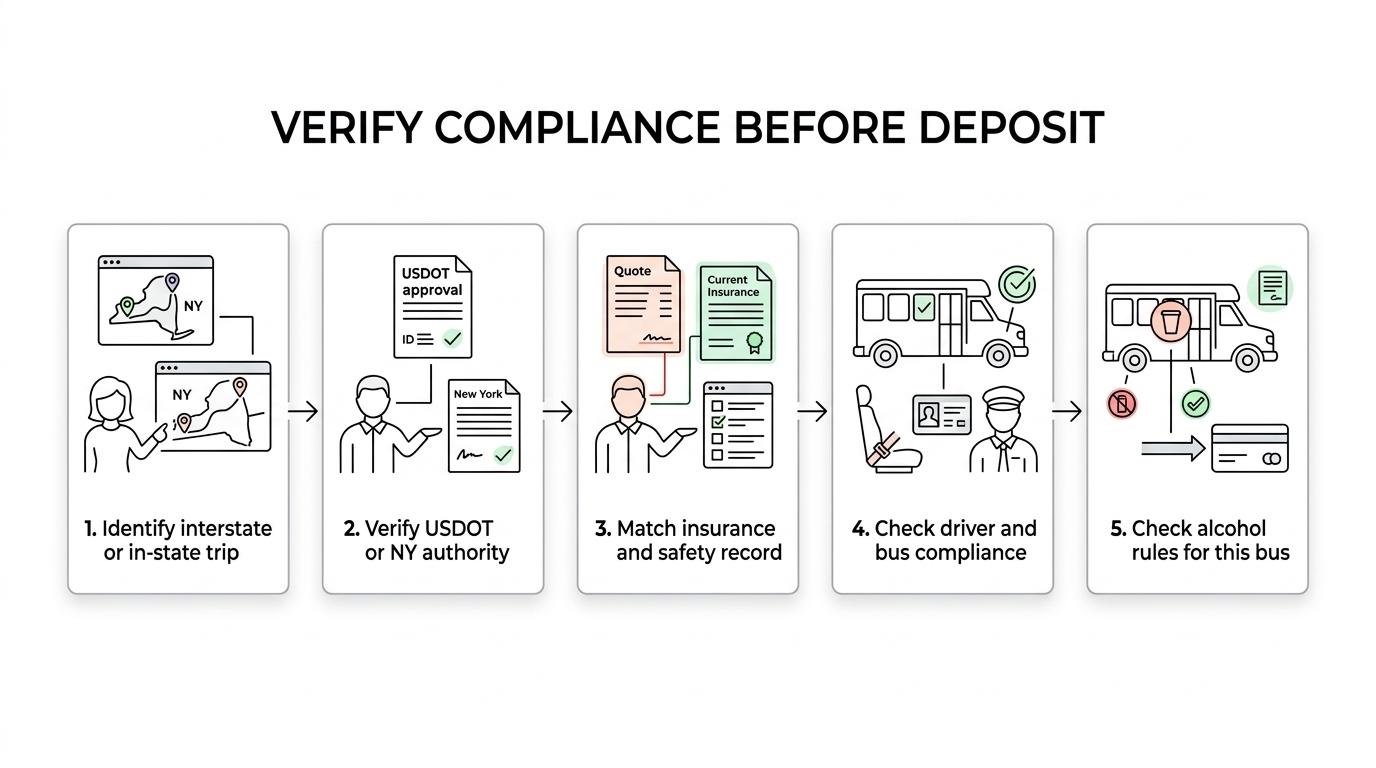
A practical sequence helps here too. Step 1: request a certificate of insurance or written proof that identifies the insured entity. Step 2: compare the company name on the quote with the insured name on the document. Step 3: review public safety information tied to the operator rather than the broker, if a broker is involved. Pro tip: if the name on the quote and the operating company name do not match, ask who is actually running the trip.
NYSDOT’s regulatory framework adds another layer because commercial passenger vehicles in New York may be subject to inspection rules and related fees. That does not tell you whether one operator is better than another, but it does tell you that compliance is not optional.
“NY Limo Bus Inc. says it has provided celebration and group transportation since 2008.”
What documents should a legitimate party bus operator be able to show you?
A legitimate operator should be ready to discuss authority, insurance, vehicle details, and driver qualifications in clear terms. If a provider hesitates on basic compliance questions, treat that as a warning sign.
Ask for the documents after you have the initial quote, not after you have paid. That timing matters because it gives you a clean exit if the answers are vague.
- Operating authority: USDOT number for interstate service and any applicable New York authority for in-state compensated trips.
- Insurance proof: current coverage tied to the operating entity and vehicle category.
- Vehicle details: year, make, model, seating layout, and legal passenger capacity.
- Driver credentials: the proper commercial license class and any required passenger qualification.
- Contract terms: deposit rules, overtime rates, cancellation policy, damage terms, and itinerary assumptions.
A provider like NY Limo Bus Inc., which offers party bus and group transportation in the Tri-State area, is working in a document-heavy category. That is normal, not a red flag.
Are the driver’s credentials right for a party bus?
They must match the vehicle and service type. The right answer includes a properly qualified commercial driver, not just someone with experience driving large vehicles.
Ask what license class applies to the bus you reserved and whether a passenger endorsement is required for that vehicle and operation. Ask whether the driver is employed directly by the operator or subcontracted. If the company uses subcontractors, ask who will actually appear on trip day.
Do not stop at “our drivers are professional.” Ask whether the driver is assigned based on the booked vehicle’s size and use. That matters because a 14-passenger style vehicle, a limo bus, and a larger charter-style party bus can fall into different compliance buckets. Pro tip: a driver can be excellent and still be the wrong legal fit for the specific vehicle.
Should you book by the hour or by the trip?
It depends on the route structure. Hourly pricing fits multi-stop nightlife plans, while trip pricing works better for direct transfers, weddings, and one-way event moves.
Compare how each structure handles time risk. With hourly pricing, you gain flexibility for extra stops, venue delays, and photos, but you also take on overtime exposure. With trip pricing, your cost can be easier to predict, but route changes may trigger add-on charges.
If your plan includes waiting time, a club circuit, or uncertain venue release times, hourly often makes more sense. If you just need a hotel-to-venue transfer and a later return, a fixed trip rate may be cleaner. The trade-off is simple: flexibility versus cost certainty.
Ask one extra question many renters miss: what starts the clock? Some companies count garage departure, some count scheduled pickup, and some apply minimum-hour blocks.
Is a party bus the right vehicle, or would a limo or charter bus fit better?
The right vehicle depends on group size, event style, and how much movement inside the vehicle you want. A party bus suits social trips, a stretch limousine suits smaller formal groups, and a charter bus suits larger point-to-point transport.
A party bus usually makes sense when the ride itself is part of the event. A stretch limousine is often better for a wedding couple, executive arrival, or a small VIP group. A charter bus is usually the better answer for larger groups that care more about efficient seating and luggage than onboard celebration features.
Do not assume “bigger is better.” A larger bus may raise parking limits, route restrictions, and cost. If your pickups are on tight urban streets, a smaller vehicle may save time and reduce maneuvering issues. Common misconception: the highest passenger capacity listed in a quote is the most comfortable choice. It is usually the legal maximum, not the roomy one.
How do pickup timing, route changes, and stop counts affect the quote?
They affect the quote immediately. NY Limo Bus Inc. notes that accurate pricing starts with the event date, passenger count, pickup and drop-off locations, and trip details.
Think through the route in three steps. Step 1: lock the first pickup address and time. Step 2: decide how many intermediate stops are essential rather than optional. Step 3: identify the latest possible release time so overtime can be estimated realistically.
This is where many bookings drift off course. If you ask for “a night out in Manhattan” and leave the stop count vague, the quote may be based on assumptions that do not match the real plan. If then the plan changes on the day, the price often changes with it.
A smart client provides a route skeleton even if the nightlife details are still moving. That lets the operator quote the trip on distance, dwell time, parking realities, and expected duty hours instead of guessing.
“NY Limo Bus Inc. says quote requests are built around the event date, passenger count, pickup and drop-off locations, and trip details.”
What should the rental agreement say before you place a deposit?
It should state the vehicle, capacity, schedule, rate basis, extra-fee triggers, and refund terms in writing. If those points are missing, the contract is incomplete for a party bus rental.
Read the agreement slowly and match it against your plan. A clean contract reduces disputes because it fixes the assumptions behind the quote.
Look for these items:
- Vehicle assignment: exact or equivalent vehicle language, passenger capacity, and any substitution policy.
- Pricing method: hourly or trip rate, minimum hours, overtime rate, fuel or toll handling, and cleaning or damage terms.
- Timing rules: pickup grace period, waiting time, stop limits, and what counts as a late release.
- Cancellation terms: deposit status, refund windows, and weather or event-cancellation language.
Pro tip: if the contract says “subject to availability” after you already placed a deposit, ask what is actually reserved.
Do New York alcohol and open-container rules affect party bus trips?
Yes, they can. New York’s open-container law generally makes it a traffic infraction for a driver or passenger in a motor vehicle on a public highway, street, or road to drink alcohol or possess an open container, but the DMV manual also notes exemptions for passengers in stretch limousines and certain permitted vehicles.
This is one of the most misunderstood parts of party bus rental. People often assume that any vehicle marketed for celebrations automatically allows onboard drinking. That is not a safe assumption. The rule can depend on the vehicle type and whether it displays the required commerce certificate or permit.
So ask the operator a direct question: does New York’s exception apply to the exact vehicle being assigned to my trip? If yes, ask how the company manages compliance. If no, adjust the plan before trip day. That simple question can prevent an avoidable stop, citation, or trip disruption.
Are vehicle inspections, seat belts, and safety equipment worth asking about?
Yes. They are basic due diligence, and they tell you whether the operator thinks like a carrier or just like a seller.
NYSDOT states that charter, contract, or common carrier vehicles providing commercial passenger service generally require an $85 per-vehicle inspection fee per inspection unless exempt. You do not need to audit that process yourself, but you should ask whether the vehicle is current on required inspections.
Seat belts are another concrete checkpoint. FMCSA says large buses manufactured after November 2016 must provide passenger seat belts. If your event depends on a larger bus, ask whether the specific bus has seat belts and how many. Pro tip: “newer fleet” is not the same as “this assigned bus has seat belts at every passenger position.”
What last-minute checks should you make on trip day?
Make three checks before anyone boards: confirm the vehicle, confirm the driver, and confirm the itinerary. Those quick checks catch most day-of errors.
Step 1: match the arriving vehicle to the contract description. Check the vehicle type, size, and visible condition. Step 2: confirm the driver knows the lead contact, destination sequence, and scheduled end time. Step 3: ask where passengers should sit if seat belts are present and whether any onboard rules apply.
This is also the moment to settle practical details that people forget on booking day: cooler policy, glass restrictions, smoking rules, and cleanup expectations. If the trip includes minors, prom guests, or a school-adjacent event, ask again about supervision rules.
If something is off, do not assume it will sort itself out once the music starts. A trip-day mismatch is easiest to fix before departure, while the full group is still curbside and the contract is in your hand.