

Party Bus Rental NYC Prices: 7 Cost Factors to Know
Party bus rental NYC prices vary because you are paying for more than a vehicle. You are also paying for a commercial driver, a timed route, and operating logistics inside one of the most regulated traffic markets in the country. NY Limo Bus Inc., a luxury ground transportation provider in the Tri-State area, treats pricing the same way many operators do: the real cost comes from vehicle type, trip design, and service conditions.
TL;DR: Summary
- Party bus rental NYC prices depend most on vehicle type, trip scope, and operating logistics, not on a single citywide flat rate.
- Manhattan parking can add real cost fast: NYC DOT bus parking meters run from 7 am to 7 pm except Sundays, charge $20 per hour, and carry a three-hour limit.
- Public GSA rate ladders show why size matters: a 15-passenger-or-less shuttle bus has a $439.73 maximum daily rate, a 35-passenger-or-less shuttle bus $625.80, and a 55-passenger-or-less coach bus $807.05.
- NY Limo Bus Inc. and similar operators need exact pickup points, stops, wait time, return time, and timing buffers before a quote is truly comparable.
- To control cost, right-size the vehicle, reduce idle time, and compare quotes line by line for parking, tolls, overtime, and extras.
That is why a cheap-looking quote can grow once waiting, staging, parking, or extra stops are added. If you want a number you can trust, focus on the seven cost factors below and compare every quote against the same itinerary.
What actually determines party bus rental NYC prices?
Party bus rental NYC pricing is driven first by trip scope, then by vehicle class. NY Limo Bus Inc. identifies time, distance, vehicle category, and trip complexity as the main quote drivers, which matches how most operators build real proposals.
A party bus quote usually starts with a simple question: what exactly has to happen from pickup to final drop-off? If the run is a direct transfer with one pickup and one destination, pricing tends to be cleaner. If the plan includes multiple borough pickups, a dinner stop, a photo stop, venue waiting, and a late-night return, the same vehicle can cost meaningfully more because the service window and the risk window both grow.
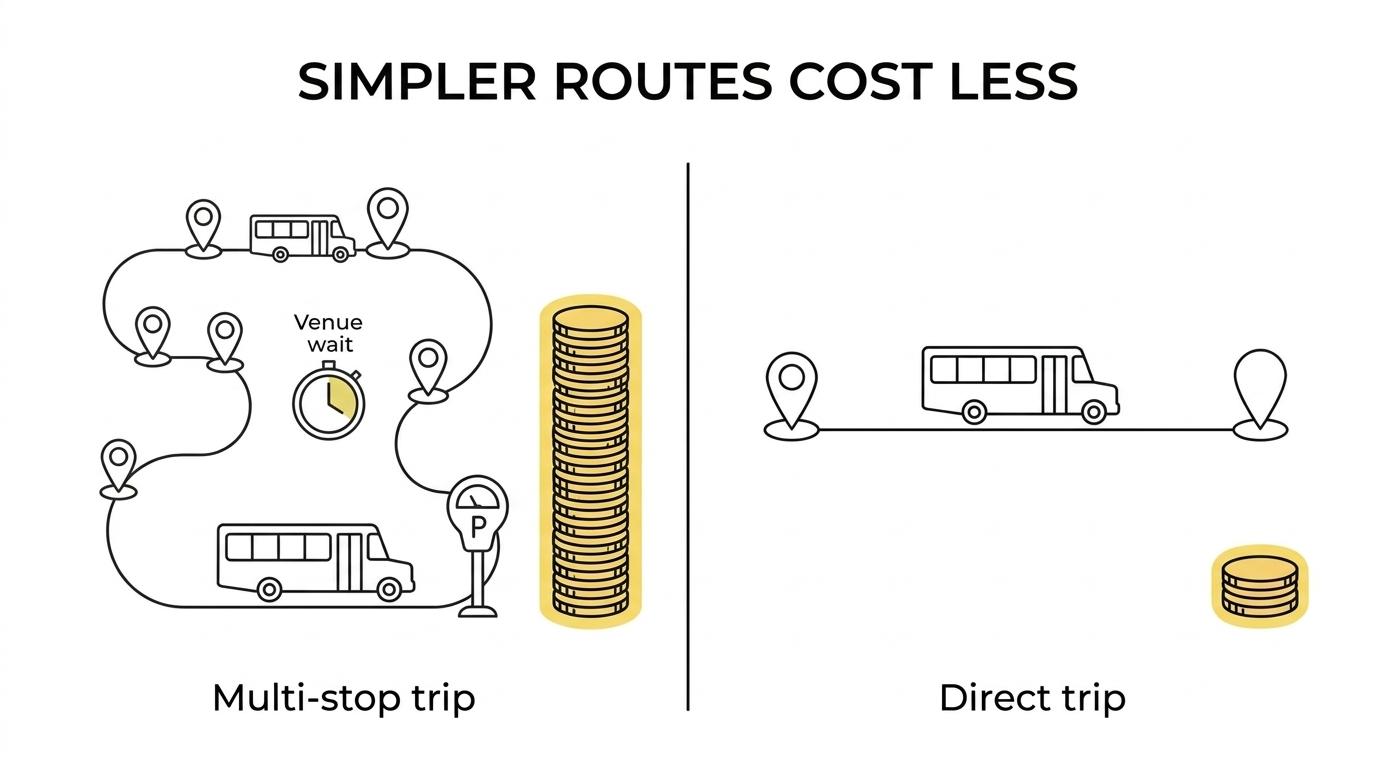
A common mistake is asking for a flat price before the route is defined. If the operator has to hold the vehicle longer, reposition it, or protect against schedule slippage, the quote has to cover that exposure. In NYC, a moving celebration is still a commercial transportation job with real staging, parking, and timing constraints.
“NY Limo Bus Inc. builds quotes around time, distance, vehicle class, and trip complexity, which is the right framework for NYC party bus pricing.”
Why can two NYC party bus quotes look far apart?
Two quotes can differ because they may price different service models. One operator may quote only core driving time, while another includes staging, overtime risk, tolls, parking, or a higher-spec limo bus experience from the start.
The first gap is often the billing window. Some quotes reflect only passenger-facing time. Others effectively cover garage-to-garage time, which can include vehicle dispatch, repositioning, and return routing. That does not mean one provider is wrong. It means the scope may not match.
The second gap is service design. A quote for a plain shuttle-style run is not the same as a quote for a limo bus experience with a more specialized interior and event pacing. Do not assume the lower hourly rate is the lower final bill. A lower base rate can still lose value if it excludes parking, overtime, or wait time that your itinerary will almost certainly trigger.
What are the 7 biggest NYC party bus cost factors?
The biggest NYC cost factors are vehicle size, rental length, route design, time pressure, local operating fees, and extras. Those factors stack together, so a modest itinerary change can move the total more than many riders expect.
Below are the seven factors that usually matter most when you request or compare a party bus quote in New York City:
- Vehicle class and capacity: A shuttle-style bus, limo bus, and full-size coach sit on different pricing tiers because size, build-out, and operating costs differ.
- Rental duration and minimums: Many event vehicles price around time blocks, not simple point-to-point mileage, so a short outing may still trigger a minimum service window.
- Route distance and deadhead time: The guest ride may be short, but the operator may still need meaningful repositioning time before or after service.
- Stop count and wait time: Every added pickup, dinner stop, photo stop, or venue hold increases trip complexity and the chance of overtime.
- Date and time pressure: Prom nights, weddings, holiday periods, and peak weekend nights usually compress availability and reduce pricing flexibility.
- Parking, tolls, and local rules: In Manhattan, metered charter bus parking and private lot use can become real line items, especially if the vehicle must stay nearby.
- Service extras and special handling: Airport coordination, venue timing buffers, décor requests, red carpet setups, or staging instructions can change staffing and timing assumptions.
If you remember only one thing, remember this: the quote follows the run. Change the run, and the number often changes with it.
How do shuttle-style buses, limo buses, and coach buses compare on price?
Public rate ladders show a clear size-based pricing pattern. GSA ceiling rates place a 15-passenger-or-less shuttle at $439.73 daily max, a 35-passenger-or-less shuttle at $625.80, and a 55-passenger-or-less coach at $807.05.
Those figures are not retail party bus packages, and they are not a promise of what a private event operator will charge in NYC. They are still useful because they show the basic market truth: larger bus categories generally cost more to place in service than smaller ones.
The trade-off is straightforward. Shuttle-style vehicles tend to be the budget-minded end of group transportation. Limo buses add event-oriented interiors and can command a different price position even when their passenger counts look similar on paper. Coach buses are built for larger groups and route efficiency, but they are not automatically the best fit for a celebration with many short stops. Match the vehicle to the event format, not just the headcount.
How should you define trip scope before asking for a quote?
Define the trip before you ask for price. A usable NYC quote needs passenger count, exact pickup points, stop sequence, service hours, and any wait time or venue buffers.
Step 1 is to lock the people count and luggage profile. Twenty guests with no bags is a different planning problem from twenty guests with airport luggage, gift boxes, or event materials. If passenger count is uncertain, give the operator a realistic range and note the latest date for final confirmation.
Step 2 is to map the itinerary in time order. NY Limo Bus Inc. advises confirming pickup points, stops, wait time, return time and airport or venue timing buffers before comparing price. That is practical advice because two quotes cannot be compared fairly if one assumes a strict transfer and the other assumes event-style waiting.
Step 3 is to list any service extras up front. If the run needs airport coordination, décor, staging at a venue, or ceremonial timing, say so early. A common mistake is adding those items after the initial quote and then treating the revised number as a surprise.
How do Manhattan parking rules change the final party bus cost?
Manhattan parking rules can materially raise the final cost. NYC DOT limits bus parking to authorized spaces, requires meter payment, and sets a three-hour time limit in metered bus spaces during active hours.
This matters because many party bus clients expect the vehicle to stay close while the group is inside a venue. According to NYC DOT, bus parking meters are generally active daily from 7 am to 7 pm except Sundays, cost $20 per hour, and carry a three-hour maximum stay. In Lower Manhattan, operators cannot park for more than three hours, and some trips may require private off-street lots instead.
A common misconception is that parking is a minor add-on. In practice, if the bus must wait near the venue, reposition to a legal spot, or use a private lot, the price can rise quickly without any change in mileage. If your event includes a long dinner or venue hold in Manhattan, ask where the vehicle will legally stage before you compare totals.
“NY Limo Bus Inc. serves the Tri-State area, so staging, parking, and repositioning rules can matter just as much as mileage on a Manhattan run.”
How should you compare party bus quotes line by line?
Compare quotes item by item, not just by total. The lowest number is only cheaper if it includes the same hours, route, parking exposure, amenities, and cancellation terms.
Start with the service window. Is the quote based on passenger-facing time only, or does it include dispatch and repositioning? Then verify the vehicle category. A shuttle bus and a limo bus may both fit the group, but they are not the same product. After that, check whether the route assumptions match your actual event plan.
Use a simple checklist when you review each proposal:
- Billing window: passenger hours or full service hours
- Vehicle category: shuttle, limo bus, or coach
- Route scope: pickup count, stops, waiting, return location
- Operating costs: tolls, parking, taxes, gratuity if listed
- Risk terms: overtime, cleaning, damage, cancellation, change fees
A useful rule is this: if one quote looks much cheaper, ask what was excluded. Very often, that question explains the gap faster than any rate discussion.
When does a larger party bus save money per passenger?
A larger vehicle can save money when it replaces multiple smaller vehicles or prevents repeat trips. Per-passenger value improves when the bus is close to right-sized and the route is efficient.
If one bus can move the whole group in a single coordinated run, the total cost per rider may beat the combined cost of several smaller vehicles. The savings are not just financial. One vehicle reduces missed pickups, fragmented arrivals, and the need to manage several drivers at once.
Still, bigger is not always better. If the group is much smaller than the bus capacity, you may be paying for unused space, higher operating cost, and harder parking. Another common mistake is undercounting guests to save money, then needing a last-minute upgrade. In NYC, last-minute changes can be expensive because inventory and timing are tight.
How can you reduce party bus rental cost without increasing service risk?
The best way to cut cost is to simplify the run without weakening the plan. Centralized pickups, shorter idle windows, and realistic timing usually matter more than chasing the absolute lowest quote.
First, trim the itinerary before you trim the vehicle. One central pickup often costs less than three neighborhood pickups. A direct return after the main event usually costs less than an open-ended late-night hold. If your venue schedule is fixed, build the trip around that anchor and remove optional stops that add little value.
Second, right-size the bus. If the group is small and the event does not need a larger party layout, a simpler vehicle category may do the job. If the group is large enough to justify a bigger bus, filling one vehicle efficiently can be the cheaper move.
Third, move the event away from peak pressure when possible. Friday and Saturday nights, prom season, and major holiday periods tighten supply. If your date is flexible, even a small schedule shift can widen options. Ask the operator what changes would lower the quote without changing the experience. That question usually gets a more useful answer than asking for a discount.