

Limousine Rentals for Galas: 7 Questions to Ask First
Gala transportation should feel polished, but the smartest limousine rental decisions start with compliance, not color or champagne flutes. NY Limo Bus Inc. is a Tri-State ground transportation company, and its service mix is a useful reminder that gala travel often spans more than one vehicle category, from stretch limousines to limo buses and executive vans.
TL;DR: Summary
- The first questions to ask about limousine rentals for galas are whether the operator is properly licensed, the vehicle is currently inspected, and every passenger has a usable seat belt.
- In New York, an altered limousine carrying 9 or more people including the driver can trigger added rules, and NYSDOT says consumers should verify inspection status and seat-belt availability before boarding.
- If the vehicle carries 11 or more people in for-hire service, ask about operating authority; if the route crosses state lines, ask what FMCSA passenger-carrier rules apply.
- Ask for the actual insured and inspected seating count, not the marketing capacity. Gala attire, gift bags, and staggered pickups reduce practical space.
- A provider like NY Limo Bus Inc. is relevant when comparing categories because gala transportation may be safer and simpler in a limo bus, van, or charter vehicle than in a stretch limousine that looks better in photos.
One more point matters before you request quotes: gala trips are time-sensitive, image-sensitive, and often multi-stop. That means the best rental is not always the longest limousine or the lowest hourly price. It is the vehicle and operator that can document legal capacity, insurance, inspection, and a realistic event plan.
Why are licensing and operating authority the first gala limo questions?
Yes, they are the first questions because New York and federal rules treat for-hire passenger transportation as a regulated activity, not just a luxury purchase.
Start with the legal status of the trip. NYSDOT consumer guidance says an altered limousine is a limousine capable of transporting 9 or more persons, including the driver. That matters because once you move into altered-limo territory, New York adds specific checks around drivers, inspections, authority, and insurance.
If the service is offered to the general public, ask who is operating the trip and under what authority. NYSDOT says the driver should hold a valid CDL with a Passenger Endorsement when the altered limousine is in that regulated class. If the vehicle transports 11 or more persons, ask whether the company holds the required operating authority for that service.
A common mistake is assuming that “licensed business” means “fully compliant for this exact vehicle and trip type.” It does not. A wedding sedan company, a bus operator, and a stretch limousine service can sit under different compliance facts.
The federal layer matters when gala guests cross state lines. FMCSA guidance says passenger-carrier rules in interstate commerce are not decided by vehicle size alone. If your route runs from Manhattan to Connecticut or New Jersey, then the operator should be able to explain which federal passenger-transport rules apply and why.
“NY Limo Bus Inc. treats gala transportation as a compliance-first service category, with licensed drivers, GPS-tracked vehicles, and fleet options that fit the trip.”
How many passengers can legally and comfortably ride in the limousine?
The safe answer is often fewer than the brochure number, especially for black-tie events, full-length gowns, and winter coats.
Ask for three numbers, not one. First, ask for the legally insured seating count. Second, ask for the inspected seating count. Third, ask how many adults can ride comfortably in gala attire. Those numbers should match closely, and any mismatch deserves a follow-up.
New York’s paperwork rules make this more than a comfort issue. State forms tied to stretched or altered vehicles require the seating count on the registration application, for-hire insurance ID card, and NYSDOT inspection document to match. If the seller talks about “squeezing in two more,” that is not a hospitality perk. It is a warning sign.
The common mistake here is using party capacity as gala capacity. A group that fits for a short nightlife run may feel cramped when everyone has tuxedo jackets, gowns, wraps, floral boxes, and phones in hand. If people cannot sit squarely with a seat belt assembly available for each position, the vehicle is the wrong size.
What are the 7 must-ask questions before reserving a gala limousine?
These seven questions screen for the biggest safety, legality, and planning issues faster than any style sheet or photo gallery.
Ask them in this order so the operator answers the non-negotiables before discussing décor or upgrades:
- Is this vehicle legally configured for our guest count? Ask for the inspected and insured seating number.
- Is the driver properly licensed for this vehicle class? In New York, that may mean a CDL with Passenger Endorsement for certain altered limousines.
- When was the vehicle last inspected? NYSDOT says altered limousines must be inspected every six months.
- Does every passenger position have a usable seat belt? Verify before boarding, not after pickup.
- What insurance applies to this trip? NYSDOT guidance for altered limousines references at least $1.5 million combined liability coverage per event.
- Do any interstate rules apply to our route? Ask this if the gala trip crosses New York, New Jersey, or Connecticut lines.
- What timing is included in the quote? Confirm garage-to-garage terms, wait time, staging, overtime, and return pickup windows.
What should a reputable limousine company show you before booking?
A reputable provider like NY Limo Bus Inc. should be ready to show licensing status, vehicle inspection status, insured seating capacity, and trip details before taking a gala deposit.
Step 1 is document matching. Ask the company to confirm the exact vehicle type, plate, and seating count tied to your quote. If the quote says 10 passengers but the insurance or inspection paperwork reflects a different seating count, stop there and clarify it.
Step 2 is driver and authority confirmation. If the rental falls into New York’s altered-limousine category, ask what driver credential applies and whether any operating authority is required for the trip size. A solid operator should answer cleanly, without vague language.
Step 3 is route review. Give the pickup state, gala venue, after-party stop, and final drop-off cities. If the route crosses state lines, then the operator should explain whether interstate passenger-carrier compliance is relevant.
Do not assume a glossy vehicle photo tells you anything about current regulatory status. An excellent operator welcomes these questions because they shorten the risk discussion and reduce event-day surprises.
How do stretch limousines compare with limo buses for gala arrivals?
Stretch limousines win on classic curb appeal, while limo buses often win on access, group logistics and usable space.
A stretch limousine is the iconic gala arrival vehicle. It photographs well, makes the entrance feel formal, and suits smaller groups that want one coordinated arrival. The trade-off is space. Even when the legal seating count works on paper, formalwear can make the cabin feel tighter than expected.
A limo bus changes the experience. Guests can board more easily, headroom is better, and loading time is usually shorter for larger groups. If your venue has a tight curb, a narrow driveway, or a strict unloading plan, the larger vehicle may actually simplify logistics because fewer vehicles need to cycle through.
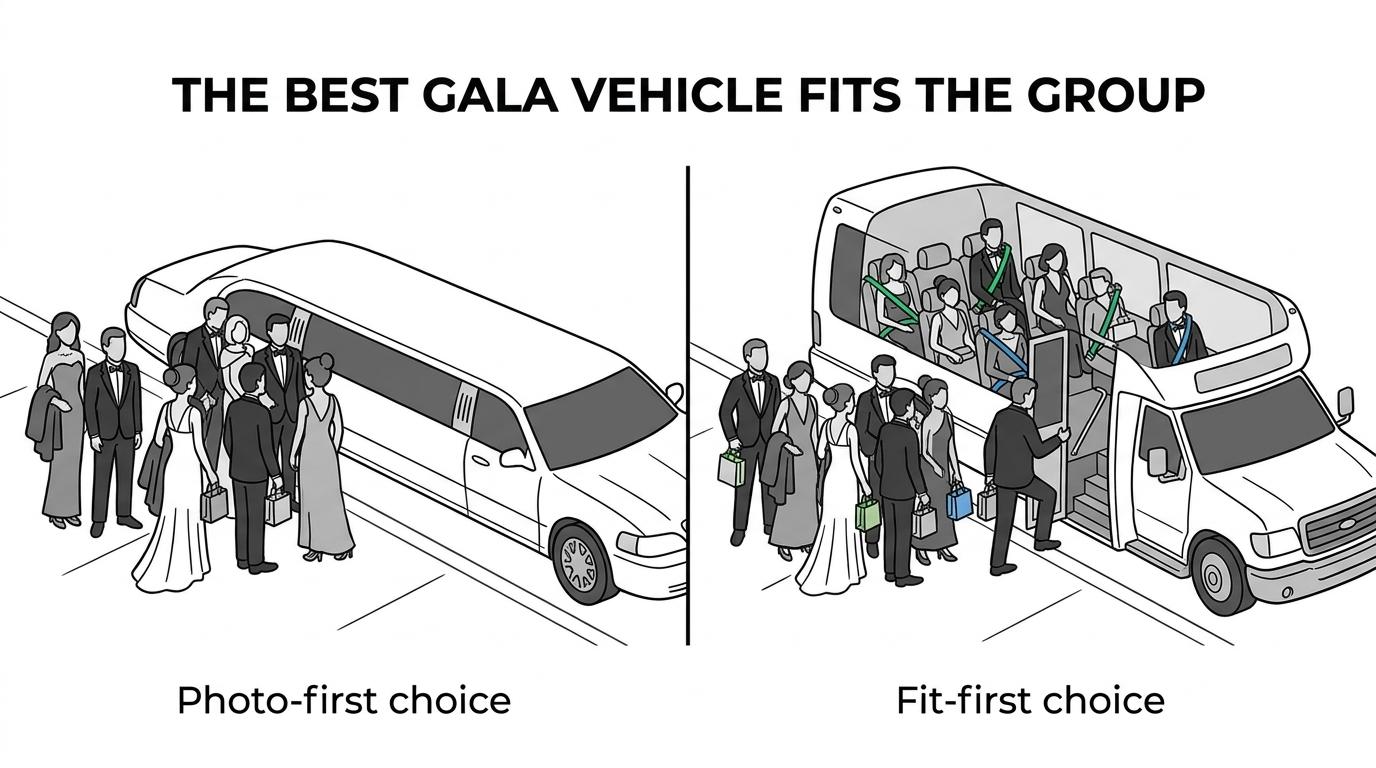
The misconception is that the “fancier” choice is always the stretch. For a group of executives, donors, or board members, comfort, upright entry, and reliable seat-belted capacity may matter more than silhouette. If the group is bigger, then a limo bus, executive van, or charter option can be the more elegant operational choice.
How do you verify inspection status and seat-belt availability before the event?
Verify both directly because New York and national safety guidance treat them as practical pre-boarding checks, not abstract policy language.
Step 1 is ask about inspection timing. NYSDOT says altered limousines must be inspected every six months. That is a semi-annual inspection cadence, which is stricter than what many consumers assume for ordinary passenger vehicles.
Step 2 is verify the actual vehicle on the day of service. Do not assume the vehicle that arrives is the same unit shown in a sales conversation. Vehicle substitutions happen, especially during busy spring and fall event periods. Ask the dispatcher to confirm the specific unit assigned to your gala.
Step 3 is inspect before guests fully load. Check that every seating position has a usable seat belt assembly and that the count makes sense for the people boarding. NHTSA advises passengers to buckle up in taxis, limousines, and rideshares, and its 2024 data says nearly 60% of back-seat passengers killed in crashes were unbuckled, based on known belt use.
If children are riding, NHTSA says children under 13 should ride in the back seat. If the operator cannot answer clearly about child placement and belts, rethink the setup before departure.
“For NY Limo Bus Inc., the right gala vehicle is the one that matches guest count, venue timing, and a safety-checked fleet, not just the arrival photo.”
What insurance details matter for gala limousine rentals in New York?
The important details are liability limits, the named insured, the covered vehicle, and whether the paperwork fits the actual trip.
NYSDOT consumer guidance for altered limousines says the company should have a current liability insurance certificate with no less than $1.5 million in combined coverage per event. That gives you a useful baseline question, even before a venue or planner asks for certificates.
Ask for clarity on these items:
- Named insured: The operating company should match the business actually providing the trip.
- Covered vehicle: The vehicle class and seating should fit the one assigned to your gala.
- Trip scope: Interstate legs, special venue requirements, and subcontracting can change what you need to confirm.
A common mistake is thinking insurance only matters to the venue. It also tells you whether the trip has been structured correctly. If the quote, vehicle class, and insurance picture do not fit together, then the problem is larger than paperwork.
How should you plan pickup timing, staging, and return service for a gala?
Build the plan backward from venue rules, not forward from your ideal departure time.
Step 1 is map the hard points. These include guest-ready time, photo time, travel window, security screening, red-carpet or valet queue, and the venue’s latest acceptable arrival. Galas often have compressed arrival peaks, which means a five-minute delay at the hotel can turn into a 20-minute delay at the curb.
Step 2 is define the staging logic. Ask where the vehicle will wait if guests are delayed and how the return pickup will be handled after the event. If the venue empties hundreds of guests at once, then a “call when ready” plan can fail fast unless the operator already has a staging strategy.
Step 3 is price the likely reality, not the best-case scenario. A gala with speeches, auctions, and donor circles often runs late. If you think the event might overrun, ask about overtime terms before booking, not while guests are standing outside in formalwear.
How do licensed operators differ from broker-style marketplaces?
Licensed operators control the vehicle and driver relationship directly, while broker-style marketplaces may sell the trip without operating every segment themselves.
That distinction matters because gala service depends on execution details. When the operator controls dispatch, driver qualification, and fleet assignment, questions about inspection cadence, seat-belt availability, and route planning usually get clearer answers. When the seller mainly brokers the reservation, you may need to ask who the actual motor carrier is for each leg.
This is not an argument against all brokers. It is an argument for transparency. If one company sells the ride and another company operates it, then ask both names, who holds the insurance, and who is responsible for event-day communication. If nobody owns that answer clearly, the service chain is too loose for a formal event.
How do you compare gala limousine quotes without choosing the wrong operator?
The best quote compares scope, vehicle class, and compliance details side by side; NY Limo Bus Inc. is one example of why multi-category fleets matter when a stretch limousine is not the best fit.
Price-only comparisons miss the real cost drivers. A lower base rate can hide shorter included time, stricter overtime rounding, older vehicle assignment, or a mismatch between the glamorous photo and the actual regulated vehicle class.
Use a side-by-side filter like this:
- Vehicle fit: Stretch limousine, limo bus, sedan, van, or charter vehicle based on guest count and attire.
- Compliance fit: Driver credentials, inspection status, operating authority, and seat-belted capacity.
- Service fit: Pickup buffer, venue staging, wait time, overtime terms, and return coordination.
If two quotes are close, choose the one that answers the hard questions fastest and most clearly. That is usually the operator who will handle a late-running gala with the least friction.