

How to Pick the Right Bus Size for Group Travel Plans
Most group travel problems begin with a simple miscalculation: counting seats instead of planning the full trip.
A bus that technically fits everyone may still feel cramped if half the group is carrying roller bags, sports gear, presentation materials, or overnight luggage. The right vehicle size should support how the group will actually travel, not just how many names are on the list.
A smart process starts with confirmed passenger count, then moves to luggage volume, trip length, and the practical limits that come with commercial driving rules. That approach keeps the booking realistic and helps avoid last-minute vehicle swaps.
Confirmed passenger count should lead every group transportation decision
The first number to lock in is the final headcount, not the expected range.
That sounds obvious, but group organizers often reserve too early based on rough interest, then try to squeeze extra riders into the same vehicle. In group transportation, that usually creates problems fast. If the group grows by five or six people, the answer is rarely “we’ll make it work.” It is often a different bus category, a new luggage plan, or a second vehicle.
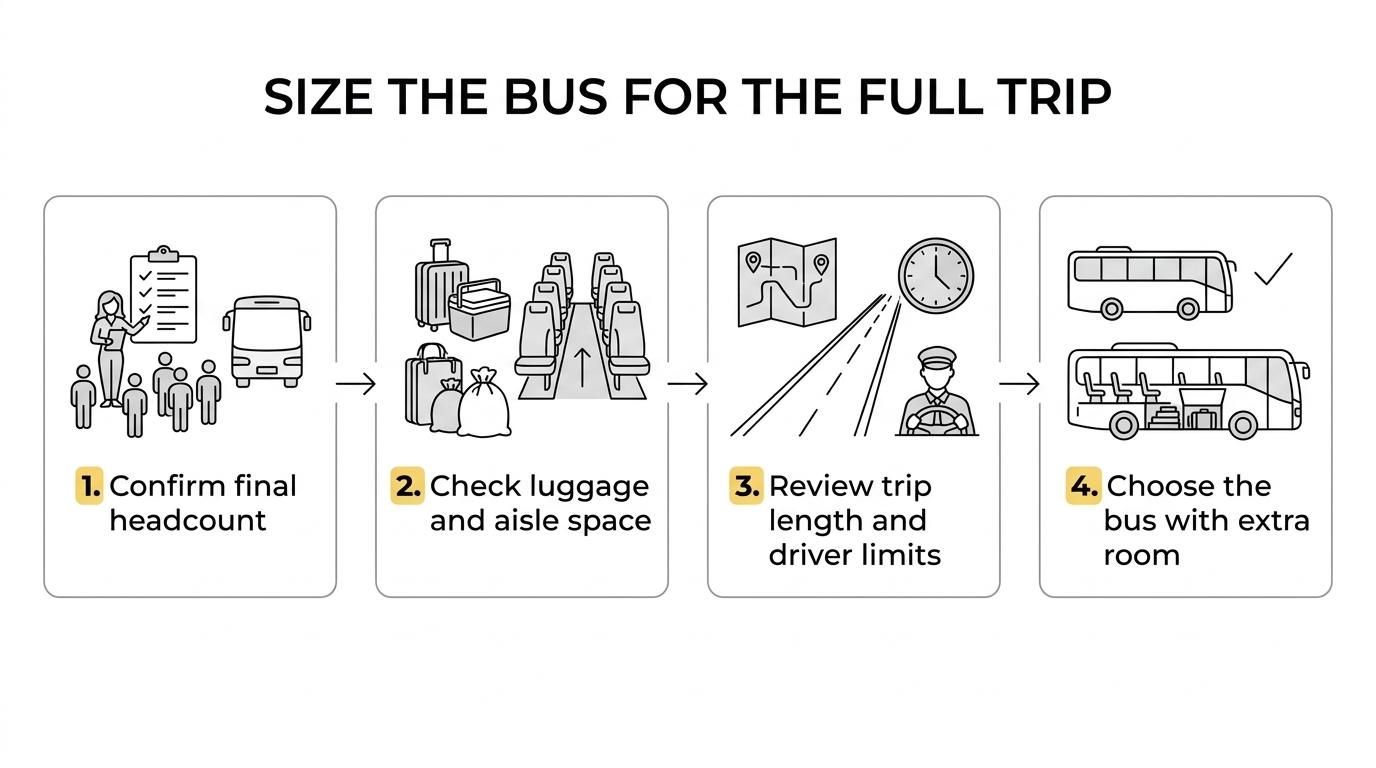
Federal definitions help frame the decision. ANSI D.16 classifies a bus as a motor vehicle with seating for nine or more people, including the driver. It defines a small bus as seating for nine to fifteen, and a large bus as seating for sixteen or more, including the driver. FMCSA guidance also uses practical categories: vans for 15 or fewer passengers, shuttles for 16 or more, and large buses for roughly 40 to 60 passengers.
That still leaves a wide middle zone, since many fleets offer multiple shuttle, mini bus, limo bus, and party bus layouts between those top and bottom ranges.
After you confirm the real rider count, leave a little breathing room if the trip includes older adults, formalwear, bulky personal items, or any setting where guests will appreciate extra elbow room.
Bus size categories for group transportation planning
The table below gives a practical way to compare common vehicle classes.
| Vehicle type | Typical capacity guidance | Storage and restroom notes | Best fit |
|---|---|---|---|
| Van | 15 or fewer passengers | Storage capacity varies, no onboard restroom | Airport transfers, small private outings, short local trips |
| Small bus or shuttle | 9 to 15 including driver under ANSI definitions | Storage depends heavily on vehicle layout | Small teams, hotel shuttles, family events |
| Mini bus | 16 or more passengers per FMCSA guidance | No restroom facilities onboard, storage capacity varies | Weddings, corporate moves, city-to-city day trips, guest transportation |
| Large bus or motorcoach | About 40 to 60 passengers | Restroom facilities onboard, luggage and equipment storage available | Long-distance travel, large group charters, multi-stop itineraries |
Within the mini bus category, fleets often carry several sizes in the 20s and 30s. That is where many group planners make the most expensive mistake: assuming every mini bus has the same luggage area, interior height, seat pitch, or entry style.
A 28-passenger bus can feel too small long before every seat is taken.
If your group count lands near the top end of any category, ask about the next size up and compare the difference in comfort, loading speed, and baggage space. The extra capacity often gives the trip a better pace, especially when there are multiple pickup points.
After a paragraph of careful planning, it helps to remember a few simple warning signs:
- A nearly full passenger list
- Oversized luggage
- Coolers or event supplies
- Guests in formal clothing
- More than two hours onboard
- Multiple pickups and drop-offs
Luggage space, restroom access, and ride comfort matter more than most planners expect
Seat count answers only one part of the question. Luggage and comfort usually decide whether the original bus choice actually works.
FMCSA notes that mini bus storage varies and that large buses are better suited to longer trips, with restroom facilities and space for luggage or equipment. That difference matters right away if the group is flying in, checking out of a hotel, carrying trade show displays, or bringing sports gear. A bus with no dedicated luggage area can become awkward fast if bags spill into seating rows or aisle space.
FMCSA safety guidance also advises passengers not to block the center aisle with luggage and to stow carry-on items securely. That is not just a comfort issue. It is part of keeping the cabin safe and usable during travel.
When comparing vehicles, ask practical questions, not just capacity questions.
- How many full-size suitcases fit: Ask for a realistic estimate, not a guess based on empty floor space.
- Will carry-on items stay out of the aisle: A crowded aisle slows boarding and creates safety concerns.
- Is there onboard restroom access: This matters more on longer highway trips, school travel, and senior group itineraries.
- What is the seat layout: Forward-facing seats, perimeter seating, and entertainment layouts each change the usable feel of the bus.
Comfort also shifts by trip purpose. A corporate team heading to a conference may care most about quiet space and efficient loading. A wedding group may care about easy boarding, climate control, and keeping formalwear neat. A limo bus or party bus group may place more value on social seating and onboard features, but the same capacity logic still applies. If coolers, décor, gift bags, or personal items are coming onboard, that “fun layout” can reduce practical space faster than expected.
For event transportation, many groups do best with realistic commercial-style vehicles rather than flashy concepts that look good in photos and work poorly in service. Real US-style shuttle and party bus formats, including Ford-based platforms common in professional fleets, tend to make planning simpler because their dimensions, loading patterns, and passenger flow are familiar and dependable.
Trip length and federal driver rules affect workable bus size
Longer trips are not just a bigger version of short trips.
They bring operational limits that can affect what vehicle makes sense, how the schedule is built, and whether one driver is enough. FMCSA guidance says a driver operating a vehicle designed to transport 16 or more people, including the driver, needs a Commercial Driver’s License with a passenger endorsement. That becomes relevant once a group moves beyond van or small-bus territory.
For interstate motorcoach travel, FMCSA says drivers cannot drive more than 10 consecutive hours. It also applies weekly on-duty limits: 60 hours in 7 consecutive days for carriers that do not operate every day, or 70 hours in 8 consecutive days for those that do. Group organizers do not need to manage these rules themselves, but they should know the rules can shape the transportation plan.
This is why a trip that seems simple on paper may need a different vehicle or driver arrangement once the full itinerary is reviewed. A same-day round trip with delays, venue waits, and evening return service can become more complex than the mileage alone suggests.
A few trip features tend to push planners toward larger or more structured transportation options:
- Long highway mileage: Restroom access and luggage space become more valuable.
- Early departures and late returns: Driver-hour planning needs extra attention.
- Multi-day schedules: Hotels, baggage handling, and duty time all affect the setup.
- Interstate service: Compliance and routing details matter more.
- Large passenger groups: One coach may work better than splitting riders between smaller vehicles.
If the trip is local, short, and light on baggage, a mini bus, limo bus, or party bus may be the right fit. If the itinerary stretches across states or runs all day, a full-size coach often makes the travel day smoother for both guests and operations.
Matching bus size to event type and group style
The same headcount can call for different vehicles depending on the event.
A 24-person executive group heading from Manhattan to a convention center does not need the same setup as a 24-person birthday group moving between dinner, a concert, and a late-night return. One group may value luggage capacity and quiet seating. The other may prioritize a social interior, lighting, and onboard entertainment.
That is why “best bus size” should always include event style.
For weddings, guest shuttles usually work best when boarding is easy and travel time is short. For airport transportation, luggage tends to decide the category more than passenger count. For school, church, and civic travel, safe boarding flow, chaperone visibility, and practical seating often come first. For nightlife or celebration service, a party bus or limo bus can be ideal if the rider count matches the layout comfortably.
It also helps to think about image and atmosphere. A luxury sedan or stretch limousine may be perfect for a small VIP movement, but once the group grows, trying to split people across multiple vehicles can weaken timing and coordination. A single bus often keeps the group on one schedule, one route, and one communication plan.
Questions to ask before reserving a bus for group transportation
A strong reservation usually starts with a better briefing.
Share the exact rider count, the ages or mobility needs of guests if relevant, the amount of luggage, every stop on the itinerary, and whether the trip crosses state lines. Those details shape the vehicle recommendation more than many first-time planners expect.
When speaking with a transportation provider, keep the questions direct:
- What vehicle size do you recommend for this exact headcount: Ask for the reason, not just the model name.
- How much luggage can that vehicle hold: Get a practical answer tied to your group’s baggage type.
- Will the itinerary require any special driver-hour planning: This is especially useful for interstate or all-day service.
- Is there a better option if comfort is the priority: A slightly larger vehicle can change the experience a lot.
- What safety features are available onboard: GPS tracking, seat belts where equipped, and well-maintained fleet standards matter.
Passengers also benefit from a few simple onboard habits. FMCSA advises staying seated while the bus is moving, wearing seat belts if they are available, and noting the nearest emergency exits before travel begins. Those steps support a safer trip no matter what size bus is selected.
In many cases, the best choice is not the smallest vehicle that can technically carry the group. It is the vehicle that gives the group enough room to board easily, store belongings properly, ride comfortably, and stay on schedule from pickup to final drop-off.
That is what makes bus sizing feel less like guesswork and more like solid planning.