

How Far Ahead to Book Group Transportation for Events
Booking group transportation is one of those event tasks that feels simple until the calendar starts filling up. A vehicle may look available today, then disappear once weddings, corporate outings, school trips, concerts, and airport runs all compete for the same fleet. That is why the safest rule is straightforward: once the event date is firm, start the reservation process.
Official guidance and institutional charter policies point in the same direction. Some programs accept requests only up to 180 days out. Others expect final itineraries no less than three weeks in advance. Federal ADA guidance even uses an example where a tour operator’s normal reservation deadline is three months before the trip date. Put together, those timelines make one thing clear. Early planning gives you better vehicle choice, cleaner logistics, and fewer surprises.
Recommended group transportation booking timeline for events
There is no single perfect lead time for every event. The right booking window depends on group size, vehicle type, season, route complexity, and whether your trip crosses state lines. A local weekday shuttle with one pickup is very different from a Saturday wedding with a party bus, a stretch limousine, and a late-night return.
A practical target is to reserve as soon as the event date and rough headcount are set, then tighten the details later. That approach matches how many transportation programs operate. Some want requests posted as early as possible to improve carrier response and pricing, while others limit how far out requests can be submitted because labor and fleet availability are hard to project too far ahead.
| Event type or vehicle need | Strong booking target | Tight but possible window | Why timing matters |
|---|---|---|---|
| Wedding limousines and party buses | 4 to 6 months | 4 to 6 weeks | Prime Saturdays book early, especially in spring and fall |
| Prom, birthdays, nightlife transportation | 2 to 4 months | 2 to 3 weeks | Popular evenings create heavy demand for limo buses and stretch vehicles |
| Corporate shuttle or meeting transportation | 1 to 3 months | 2 to 3 weeks | Routing, manifests, and pickup timing often need review |
| School, sports, or group charter bus trips | 1 to 4 months | 3 weeks | Some institutional policies ask for final itinerary no less than 3 weeks ahead |
| Airport transfers for groups | 2 to 6 weeks | 7 to 10 days | Flight tracking is easy, but vehicle count and luggage space still need planning |
| Holiday weekends and major conventions | 3 to 6 months | 3 to 4 weeks | Regional demand can tighten quickly |
| Accessible group transportation | As early as possible | 48+ hours may help in some cases | ADA-related vehicle availability can affect options |
One more timing note matters here: some providers or programs may not accept requests more than 180 days in advance. So “book early” does not always mean “book a year ahead.” It usually means getting in line early within the provider’s accepted reservation window.
What changes the booking window for group transportation
Demand is the first big factor. Saturday evenings, graduation season, wedding season, prom weekends, holidays, and major New York area events all put pressure on fleet availability. If your event lands on one of those dates, the best vehicles tend to go first.
The second factor is complexity. A single pickup and drop-off is easier to place than a route with multiple homes, hotels, photo stops, venue access rules, overtime risk, and a return near midnight. Complex trips need more planning, and more planning usually means more lead time.
Vehicle class matters too. A standard minibus or van may be easier to secure than a high-capacity party bus, a stretch limousine, or a full-sized charter bus on a high-demand date. If your group needs several matching vehicles, early booking becomes even more valuable.
A few details tend to stretch the planning window more than people expect:
- peak-season Saturdays
- multiple pickups and split drop-offs
- interstate travel
- venue loading restrictions
- late-night returns
- oversized luggage or equipment
Accessibility and compliance issues that affect charter bus timing
Accessibility requests can change the timeline in a very real way. Federal ADA guidance includes a tour bus example where the operator’s normal reservation deadline is three months before the trip date. In that example, a wheelchair user asking for an accessible bus only 48 hours before departure can be refused if all passengers were required to reserve three months ahead. The issue is not that accessibility is optional. The issue is that very late requests may run into operational limits if the provider’s normal reservation rules were already missed.
There is also a second ADA example that is useful for event planners. If a group reserved a charter bus four weeks in advance and later needs an accessible bus, the accessible vehicle can be provided if the request is made more than 48 hours before departure and no existing passenger is displaced. That is a helpful reminder that early base reservations create room to solve later details.
Compliance goes beyond accessibility. If the trip crosses state lines, the carrier should have proper operating authority for interstate passenger transportation. For-hire buses designed for 16 or more passengers also face significant insurance requirements, with federal guidance noting $5 million in insurance coverage. Those are not minor box-checking items. They affect who can legally and safely operate your trip.
When accessibility or compliance needs are in play, ask these questions early:
- Ask about accessible vehicles: if a lift-equipped bus or other accommodation may be needed, bring it up at the first inquiry
- Verify interstate authority: if the route crosses state lines, confirm the carrier is authorized for interstate passenger service
- Confirm insurance standards: if the vehicle is designed for 16 or more passengers, review the carrier’s coverage and credentials
- Build in loading time: mobility devices, baggage, instruments, and event materials can add time at every stop
What information to prepare before requesting event transportation
A fast quote is helpful. A useful quote is better. The more precise your trip details are, the easier it is to get accurate pricing, the right vehicle type, and a realistic service plan.
Official trip-request checklists often ask for the exact date transportation is needed, specific pickup and return times, and whether the trip is one-way or round-trip. They also emphasize setting aside enough time for loading and unloading passengers and equipment. That last point matters more than many planners expect. Baggage, welcome bags, instruments, AV gear, sports equipment, and formalwear all slow the boarding process.
Before you reach out, have the core trip details ready:
- Exact passenger count
- Date and service hours
- Pickup and drop-off addresses
- Stop list and timing
- Luggage or equipment volume
- Onsite contact name and cell number
It also helps to know when your final itinerary will be ready. Some institutional guidance asks for the final itinerary no less than three weeks in advance. Even if your provider does not use that exact rule, early itinerary confirmation makes dispatch, driver planning, and venue coordination much easier.
Common event transportation scenarios and realistic booking targets
Different event types create different booking pressures. The timing that feels generous for an airport transfer may be far too short for a wedding weekend or a multi-bus corporate shuttle.
Wedding and celebration transportation booking timing
Weddings usually need the longest runway. Ceremony timing is fixed, emotions run high, and the transportation plan may include more than one vehicle type. A stretch limousine for the couple, a limo bus for the wedding party, and a shuttle or charter bus for guests can all be part of the same day.
If the wedding is on a prime Saturday in spring or fall, a four to six month target is smart. If the date is less competitive, a shorter window may still work, but options will narrow. Party buses and limousines, in particular, can book quickly when multiple events overlap on the same weekend.
Corporate event shuttle booking timing
Corporate transportation often looks easier on paper, but it can become detail-heavy very fast. A meeting shuttle may need hotel pickups, airport coordination, staggered departures, executive service standards, and backup planning for delayed flights or extended sessions.
A one to three month booking window works well for many corporate moves. If the event includes conference blocks, branded scheduling, or multiple days of service, earlier is better. For groups that need exact manifests and timed arrivals, getting the reservation in place early leaves room to adjust details without rushing.
Airport, convention, and hotel group transportation timing
Airport transfers can sometimes be booked closer to the service date, especially for smaller groups. Still, large groups should not wait. Vehicle sizing depends on luggage, arrival patterns, terminal logistics, and whether everyone lands together or in waves.
Convention transportation also tends to tighten quickly because hotels, venues, and corporate groups all draw from the same regional fleet. A two to six week window may be enough for straightforward service, but major citywide events often justify much earlier booking.
School, sports, and organization charter bus timing
Institutional trips usually require more documentation and a firmer itinerary. One school district policy states that the final itinerary should be given to the bus company no less than three weeks in advance. That is a useful benchmark even outside school travel.
There is also the simple reality of travel time. Some charter bus policies note that buses are often speed-governed, meaning the trip may take longer than it would in a passenger car. If your event schedule is tight, that difference needs to be built into the timeline from the start.
Last-minute group transportation booking risks and smart backup plans
Late bookings do not always fail, but they usually cost you something. It may be vehicle choice, routing flexibility, pickup timing, or price. In some cases, it may be the loss of add-ons that matter to the experience, like matching vehicles, onboard features, or coordinated service windows.
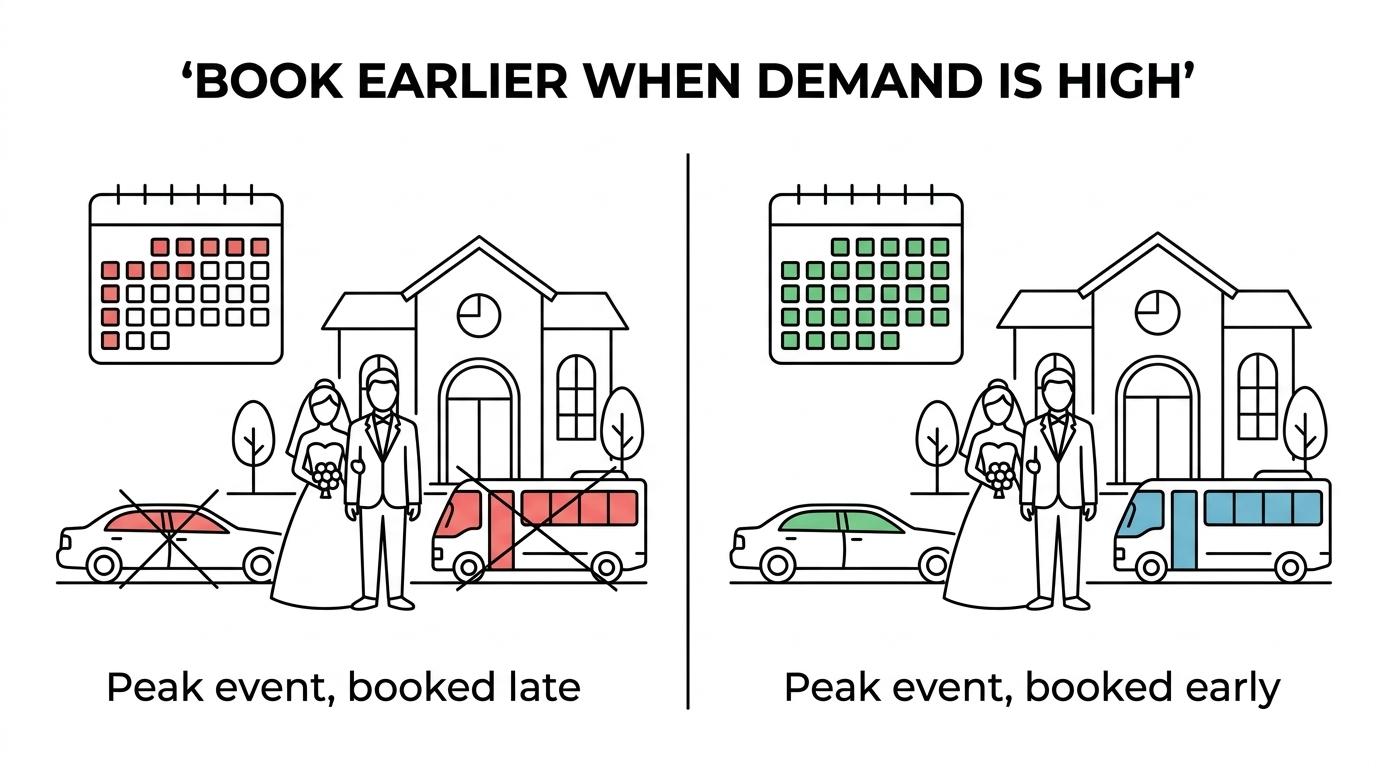
Changes close to departure can also create fees or operational friction. One university charter policy applies a cancellation fee per bus when service is canceled less than seven calendar days before the first scheduled pickup. That is one policy, not a universal rule, though it shows why reading terms early matters.
The best backup plan is simple. Reserve early, confirm details in writing, and keep a little flexibility where it counts most.
A good transportation request usually includes a realistic pickup schedule, loading time, a clear onsite contact, and a willingness to consider a nearby vehicle class if the first choice is gone. If your date is fixed and the event matters, that combination gives you the strongest position long before the wheels start moving.