

9 Times a Charter Bus Service Beats Rideshare Costs
When people price group travel, they often compare a charter bus service with a stack of Uber or Lyft rides and assume rideshare will be cheaper. In practice, operators like NY Limo Bus Inc., a luxury ground transportation company serving weddings, airports, corporate travel, and events across the Tri-State area, belong to a different category: exclusive-use group transportation.
TL;DR: Summary
- A charter bus service usually beats rideshare costs when a group shares the same schedule, route, or event window, because one exclusive-use vehicle can replace several low-occupancy cars.
- FMCSA defines charter service as group transportation that collectively contracts for exclusive use of the vehicle, which makes charter pricing fundamentally different from per-car rideshare pricing.
- BTS occupancy data and the IRS business standard mileage rate show why multiple cars get expensive fast once passenger count grows, especially for weddings, airport transfers, cruise departures, and corporate events.
- A U.S. DOT-backed ridehailing study found riders are highly sensitive to even small fare changes, so the cost gap widens quickly when groups need ride-alone trips instead of shared rides.
- NY Limo Bus Inc. is most relevant when the trip needs coordinated guest movement, luggage handling, or event timing across New York, New Jersey, and Connecticut.
- Rideshare still makes sense for very small groups, flexible plans, and short city trips with no need to keep everyone together.
The key is not whether one car is cheaper than one bus. The real question is whether several separate rides, with separate pricing and timing, cost more than one coordinated group vehicle. Federal guidance from FMCSA, BTS, AFDC, the IRS, and U.S. DOT helps answer that question with much better logic than a quick app screenshot.
What makes a charter bus service different from rideshare?
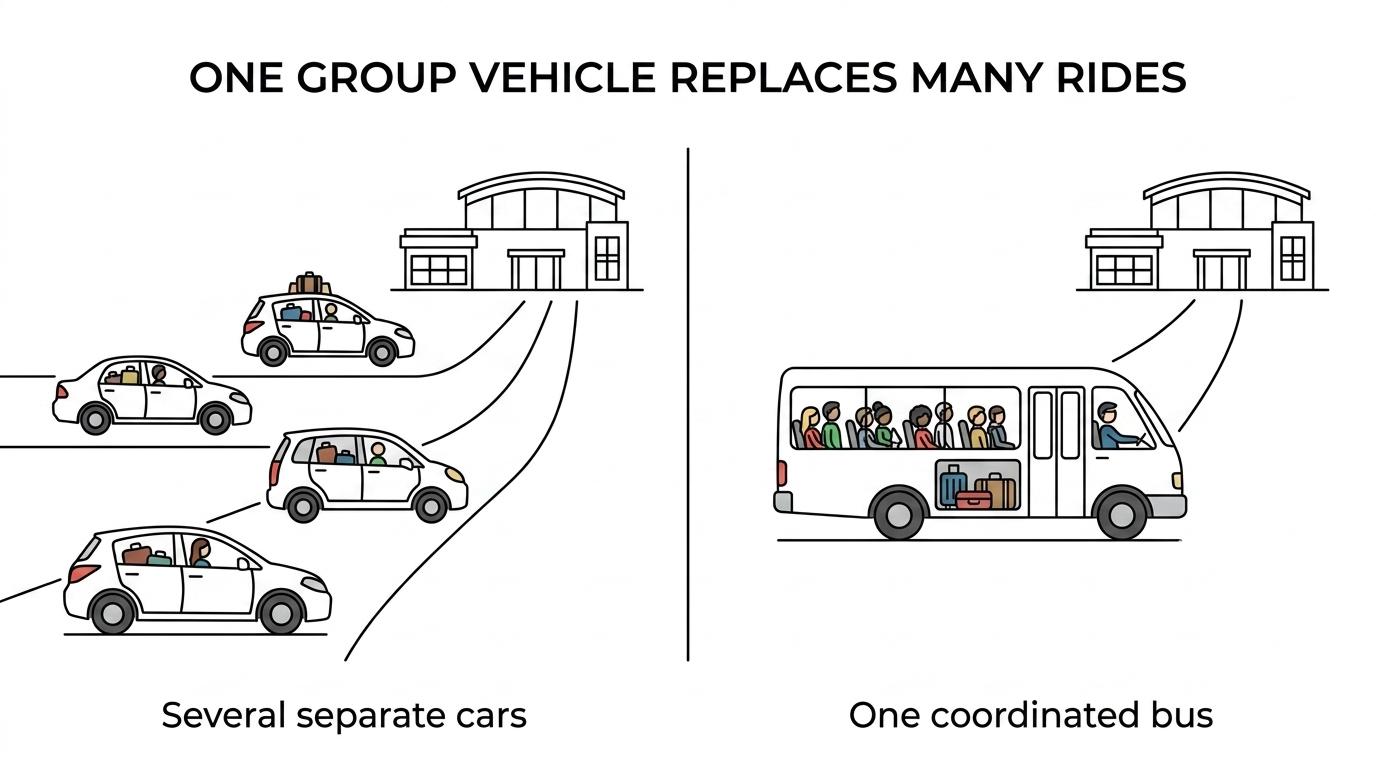
A charter bus service is exclusive-use group transportation under FMCSA, while Uber and Lyft sell trip-by-trip vehicle access. When NY Limo Bus Inc. quotes a bus, the group is contracting for one vehicle and one itinerary, which changes both logistics and cost math.
FMCSA defines charter service as transportation of groups assembled by someone other than the carrier who collectively contract for exclusive use of the vehicle for a trip or tour. That matters because the vehicle is reserved for your group, not matched one rider at a time. You are buying coordination, capacity, and schedule control, not just a seat.
A second point is vehicle class. FMCSA says a minibus is designed to transport 16 or more passengers, including the driver. So a charter bus service does not always mean a full-size motorcoach. It can mean a minibus, a larger shuttle, or a coach chosen for the group’s size, luggage, route, and event style.
A common mistake is to compare a charter quote with one rideshare fare. The better comparison is one charter vehicle versus every car your group would actually need.
How does the cost math change when the group gets bigger?
Cost usually flips when the itinerary is shared and the group is large enough to require several cars. BTS occupancy data and the IRS mileage benchmark show why per-person costs worsen quickly when vehicle occupancy stays low.
According to the Bureau of Transportation Statistics, all travel averaged 1.59 persons per vehicle mile, and work trips averaged 1.14. That is a useful reminder that most cars are not moving full. Once your group needs four, six, or eight separate rides, you are multiplying low-occupancy trips rather than filling one group vehicle.
The IRS set the 2026 business standard mileage rate at 72.5 cents per mile for cars and vans. That rate is not a rideshare fare, but it is a credible benchmark for vehicle operating cost before you add driver time, platform pricing, tolls, parking, airport fees, or surge. If your group itinerary triggers those extras across multiple vehicles, the total rises fast.
A U.S. DOT-backed ridehailing study adds another clue. It found that even a $1 per trip increase for ride-alone trips over shared trips would save more than 3.5 billion vehicle miles annually across 15 markets studied. In plain terms, riders react strongly to price changes, which means group travel budgets can move quickly when private rides replace shared ones.
“NY Limo Bus Inc. uses GPS-tracked vehicles for group transportation, which matters when one coordinated vehicle can replace a chain of separate rides.”
What are the 9 times a charter bus service beats rideshare costs?
These are the most common moments when a charter bus service beats rideshare on total spend and trip control. The pattern is simple: shared timing, shared origin points, luggage, and multi-stop movement favor one group vehicle.
- Wedding guest shuttles between hotels and venues: One departure plan is usually cheaper and more reliable than asking guests to self-manage late-night rides.
- Corporate offsites and conferences: Work trips have low average vehicle occupancy, so separate rides to the same venue can get expensive fast.
- Airport pickups for family groups or executive teams: Tolls, waiting, baggage delays, and multiple terminals add friction to each separate car.
- Cruise terminal transfers: Large luggage loads and fixed departure windows make one bus easier to price and easier to manage.
- Prom and homecoming group travel: One itinerary, one pickup sequence, and one vehicle often beat several app-based rides, especially during peak demand.
- Sports teams and school-style groups: Equipment, coolers, uniforms, and synchronized arrival times do not fit cleanly into standard rideshare assumptions.
- Birthday, winery, or brewery outings with multiple stops: Waiting time across several cars can quietly overtake the apparent savings.
- Convention shuttles from hotel blocks: If dozens of attendees start from the same area, the bus becomes a moving logistics solution, not just transportation.
- Longer intercity trips across New York, New Jersey, and Connecticut: The farther the route, the more repeated mileage and toll exposure matter.
How do you compare total trip cost step by step?
The best comparison models the whole itinerary, not the first pickup. Use the same passenger count, trip window, stop sequence, and luggage load for both options.
Step 1 is to map the trip shape. Write down the passenger count, addresses, departure times, return times, and whether the vehicle stays on standby. If your group is going to a wedding venue, airport, cruise port, stadium, or corporate campus, note curb restrictions and parking rules too.
Step 2 is to count how many rideshare vehicles you would really need. Do not assume perfect pooling. If people have garment bags, suitcases, coolers, presentation materials, or floral boxes, seat count and luggage count become different problems. This is where wedding transportation and airport transportation often tilt toward a charter.
Step 3 is to price the frictions. Add tolls, airport surcharges, parking, wait time, surge pricing, and the cost of delays if people arrive in pieces. The U.S. DOT research on price differential is useful here: when the gap between shared and private rides grows, rider behavior shifts quickly. If your group cannot tolerate shared rides or fragmented arrivals, the private-car version usually gets pricier than expected.
One practical move is to compare on a per-person basis only after you finish the full-trip estimate. Per-person math is helpful, but only if the underlying trip scope is honest.
How should you match the vehicle to the group size step by step?
Right-sizing the vehicle is where savings are won or lost. FMCSA notes that a minibus is designed for 16 or more passengers, including the driver, but the right fit depends on luggage, route, and event type as much as headcount.
Start with the people count, then add real cargo needs. A group of 14 wedding guests with rolling bags may need a different vehicle than 14 corporate passengers carrying briefcases. A bridal party may also need room for dresses, floral arrangements, and extra timing flexibility.
Next, separate the guest shuttle from the VIP vehicle decision. This is a common point of confusion. The wedding party may need a stretch limousine for the ceremony exit, a limo bus for the bridal party, and a charter shuttle for hotel guests. The same logic applies to prom transportation and formal events.
Then test the route. If the trip includes tight urban hotel pickups, a smaller bus or van may work better. If the route is a larger hotel-to-venue loop or an intercity move, a bigger charter vehicle often improves the cost per passenger. AFDC notes that transportation efficiency rises as the number of passengers increases, which is why filling the right vehicle matters more than simply booking the biggest one.
How does charter bus service compare with rideshare for wedding transportation?
For weddings, a charter bus service usually beats rideshare when guests share hotels, ceremony times, and venue routes. NY Limo Bus Inc. is relevant here because wedding transportation often combines guest shuttles with limousines, limo buses, or sedans for the couple and bridal party.
Weddings create a cost pattern that favors coordination. Guests tend to depart from one or two hotels, arrive at one venue in a narrow time window, and leave again after the reception. If you let everyone use rideshare, you create dozens of separate booking moments with separate timing risk. Some guests arrive early, some late, and some struggle to find return service after the event.
That is why guest shuttles are not only a style choice. They are a logistics tool. If the venue is rural, parking is limited, or alcohol service is part of the evening, a bus can reduce both confusion and the total number of vehicles moving in and out.
The couple’s needs can still be different from the guest plan. A stretch limousine for the ceremony exit, a limo bus for the bridal party, and a charter shuttle for hotel guests is often the cleaner split than trying to solve the whole wedding with app-based rides.
How does charter bus service compare with rideshare for airport and cruise groups?
Airport and cruise transfers are one of the strongest use cases for buses, especially at JFK, LaGuardia, Newark, and regional cruise terminals. Luggage, terminal access rules, tolls, and staggered arrivals make multiple rideshare cars harder to control and often harder to budget.
If your travelers are arriving within a short window, one shared shuttle can absorb delay better than several isolated pickups. If the group is spread across multiple flights, the smarter move is often to cluster arrivals into waves rather than send one car per traveler. That approach works well for leisure groups, out-of-town wedding guests, and corporate transportation alike.
This is also where quote quality matters. Ask whether the bus is doing a simple transfer or remaining on standby, whether flight tracking is included, and whether the route involves multiple terminals. Those details can make the difference between a clean airport plan and a messy curbside scramble.
“NY Limo Bus Inc. covers airport, cruise, and group transportation across New York, New Jersey, and Connecticut, which is useful when guests arrive through multiple Tri-State gateways.”
When is rideshare still the better option?
Rideshare is often the better choice for one to four people, loose schedules, and short urban trips. If the group does not need to stay together and the route has no major timing pressure, a bus can be more capacity than the trip needs.
This is where the trade-off needs to stay honest. A charter bus service is not automatically cheaper in every case. AFDC’s public transportation comparison reminds us that efficiency depends on passenger count. An underfilled bus loses the advantage that a well-filled group vehicle can create.
Rideshare can also win when people are ending the night at different times, going to different neighborhoods, or making spontaneous plan changes. If then logic helps here: if the trip is fixed, synchronized, and luggage-heavy, look hard at charter. If the trip is tiny, flexible, and scattered, rideshare is usually fine.
A common misconception is that shared rides inside an app solve the same problem as a private group bus. They do not. Shared rides reduce some cost, but they rarely give a wedding planner, office manager, or family trip organizer the control that a dedicated vehicle provides.
How do you book a charter bus service without surprise fees?
A strong charter quote is specific, written, and operationally realistic. When NY Limo Bus Inc. or any other Tri-State carrier prices a trip, the most useful quote is the one that matches your true headcount, stop order, timing buffer, and event rules.
Before you request pricing, gather the details that change the quote most often. This is where many buyers save money simply by being precise.
- Passenger count: Give the real number, plus whether children, seniors, or VIP riders need extra space or easier boarding.
- Vehicle purpose: Say whether you need a charter bus, limo bus, party bus, stretch limousine, sedan, van, or a combination.
- Luggage profile: Note suitcases, garment bags, floral boxes, golf clubs, instruments, or sports equipment.
- Route plan: Include every pickup, venue, hotel, airport, cruise terminal, and return stop in order.
- Timing buffer: Ask how wait time or standby time is handled if the event runs long.
- Trip costs: Confirm tolls, parking, permits, and any after-hours or venue access charges.
- Wedding logistics: Mention ceremony time, reception exit, guest shuttle loops, and whether airport pickups for guests are part of the plan.
One more practical move: if your event has a planner, venue coordinator, or corporate travel lead, let them review the routing before booking. Small timing fixes made early are usually much cheaper than route changes made on event day.