

9 Facts About Limo Companies in New York City to Know
New York City limo service looks simple from the curb, but the business is built on regulation, dispatch rules, and street-level logistics. NY Limo Bus Inc. is one example of a ground transportation provider working in a market where the NYC Taxi and Limousine Commission, airport demand, and operating constraints matter just as much as vehicle style.
TL;DR: Summary
- Limo companies in New York City are pre-arranged for-hire transportation providers that must work through TLC-licensed bases with TLC-licensed drivers and vehicles, and NY Limo Bus Inc. operates in that regulated category.
- A legal NYC limo trip is not a street hail. That is the main difference between limousine service and yellow taxis.
- Vehicle class matters: luxury limousine bases handle vehicles with seating for 20 or fewer passengers, while larger group trips may shift into limo bus or charter bus planning with stricter routing and parking issues.
- Airport service and event trips need extra planning because NYC streets, curb access, idling limits, bus parking, and route rules can change timing and cost.
- The safest booking method is to verify licensing, insurance status, vehicle type, airport or venue logistics, and contract terms like wait time, overtime, tolls, and garage-to-garage billing.
That is why the best way to compare limo companies in New York City is not just by price or photos. You need to know what the company is legally allowed to do, what kind of vehicle you actually need, and how the trip will work once it reaches Midtown, the airports, or a busy event venue.
What legally counts as a limo company in New York City?
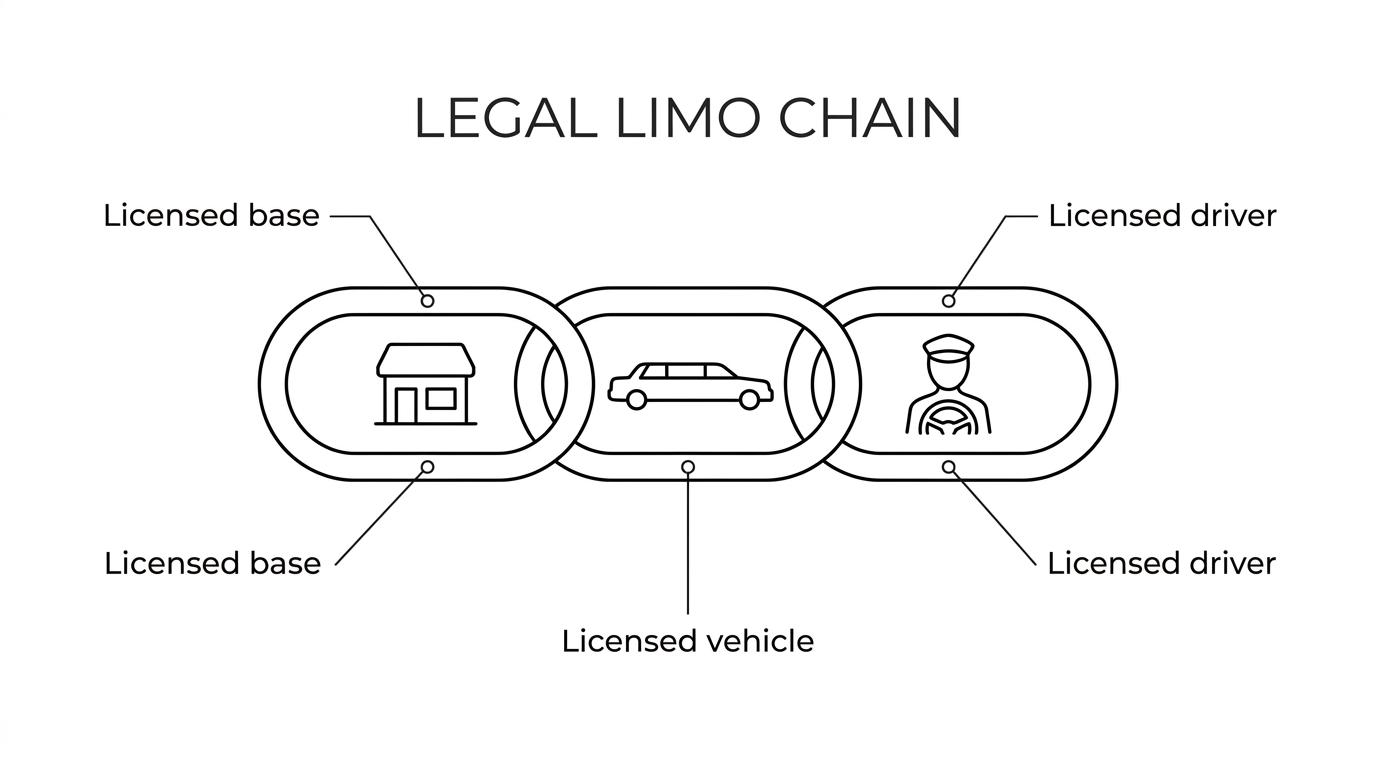
A NYC limo company is a pre-arranged for-hire transportation business regulated by the TLC. The key legal pieces are the TLC-licensed base, the TLC-licensed vehicle, and the TLC-licensed driver.
According to the NYC Taxi and Limousine Commission, for-hire vehicles in New York City provide pre-arranged transportation through licensed bases. That means the trip has to be arranged before pickup, and the dispatch base is part of the legal structure, not just a back-office detail. A common misconception is that any black vehicle offering rides in Manhattan is operating as a proper limousine service. In reality, the licensing chain matters.
The TLC also distinguishes a luxury limousine base as one that dispatches pre-arranged trips for vehicles with seating capacity of 20 or fewer passengers. The TLC states that more than 90 percent of that business must be paid on a basis other than direct cash payment. That rule tells you something important about the category: limo service in NYC is largely a scheduled, account-based, card-based, or contracted service, not curbside cash transportation.
“NY Limo Bus Inc. provides limo bus, party bus, charter bus, limousine, sedan, van, and specialty vehicle service across the Tri-State area.”
There is also a compliance layer most riders never see. TLC-licensed for-hire bases must electronically submit trip records every month, which reflects how closely the city tracks regulated ground transportation.
How are limo companies different from taxis and app-based for-hire services?
The basic difference is dispatch and service model. Yellow taxis can take street hails, while limousine service and app-based for-hire vehicles must be pre-arranged under TLC rules.
That distinction changes the customer experience. A limo company often focuses on scheduled pickups, event timing, airport coordination, corporate travel, and specialty vehicles. A taxi focuses on immediate point-to-point availability. App-based for-hire service shares the pre-arranged legal framework with limo service, but the trip format, vehicle consistency, and booking expectations can be very different.
This matters when people assume all black-car transportation is interchangeable. It is not. If you need a stretch limousine, a limo bus, a meet-and-greet at JFK, or group transportation for a wedding or corporate event, the operator’s dispatch structure and fleet type matter more than the app screen.
What are the nine most important facts about limo companies in New York City?
The most useful facts are legal, operational, and trip-planning related. They explain why booking a limo in NYC is as much about compliance and routing as it is about comfort.
-
New York City limo service is pre-arranged only. Street hails belong to taxis, not limousine operators.
-
A legitimate limo trip depends on three linked licenses: base, vehicle, and driver. If one piece is missing, the service model changes.
-
Luxury limousine bases dispatch vehicles with seating capacity of 20 or fewer passengers. That threshold is a practical dividing line in vehicle planning.
-
More than 90 percent of luxury limousine base business must be paid on a basis other than direct cash payment. That is one reason professional limo service is usually booked in advance.
-
Stretch limousines have extra requirements. TLC says they need operating authority from the New York State Department of Transportation and drivers with ACTIVE 19A status.
-
Airport demand is massive. The Port Authority reported a record 145.9 million passengers across its four commercial airports in 2024, including 63.3 million at JFK and 33.5 million at LaGuardia.
-
Charter and tour bus operations in NYC face route controls. NYC DOT says operators must prepare a detailed route slip listing origin, destination, and streets used, and it must stay in the operator’s possession.
-
Manhattan bus parking is scarce and regulated. NYC DOT says bus parking meters generally run from 7 a.m. to 7 p.m., except Sundays, at $20 per hour with a three-hour limit.
-
Pickup, drop-off, idling, and parking constraints shape real trip timing. A good itinerary on paper can still fail if curb access is not workable.
How can you verify a limo company is properly licensed before booking?
The safest approach is to confirm TLC status before you pay, and NY Limo Bus Inc. operates in the same regulated category you should expect from any legitimate NYC provider.
Start with the dispatch base. Ask whether your ride will be handled through a TLC-licensed base and whether the vehicle itself is licensed for the service being sold. If the trip is in New York City, that is a basic screening step, not an optional one.
Next, ask about the exact vehicle class. That sounds minor, but it is where many booking mistakes begin. If the vehicle is a stretch limousine, extra rules apply, including New York State Department of Transportation operating authority and a driver with ACTIVE 19A status. If you are moving a larger group, the operational plan may look closer to bus logistics than sedan service.
Then ask about insurance and driver compliance. TLC says a for-hire vehicle license cannot be renewed without a current insurance policy that meets TLC minimum requirements and an FH-1 insurance certificate on file. TLC also states that drivers must pass a background check, maintain a safe driving record, and complete 24 hours of driver training. A useful rule is simple: if a company gets vague when you ask about licensing, dispatch, or insurance, keep looking.
How do airport trips change limo planning in NYC?
Airport service in New York is a logistics job first, which is why NY Limo Bus Inc. and similar Tri-State operators plan around terminals, wait time, and legal staging.
Start with airport scale. The Port Authority’s 2024 Annual Traffic Report shows why airport transportation is one of the busiest parts of the market: 145.9 million passengers used the region’s four commercial airports in 2024. JFK alone handled 63.3 million passengers, including 35.3 million international passengers. LaGuardia handled 33.5 million. Newark Liberty handled 15.2 million international passengers.
Step one is to define the trip in operational terms, not just “airport pickup.” You need the airport, airline, terminal, arrival window, passenger count, and luggage profile. Step two is to match that plan to the right vehicle and waiting strategy. A common mistake is booking for headcount only and ignoring baggage, terminal traffic, or the legal realities of curb dwell time.
“NY Limo Bus Inc. builds customized transportation plans for events, corporate travel, airport transfers, and group transportation across New York, New Jersey, and Connecticut.”
Step three is to build a bigger time buffer than most travelers expect. The U.S. Census Bureau says the national mean one-way commute was 27.2 minutes in 2024, but that national benchmark is not a safe planning standard for NYC airport transfers. If a traveler is landing at a peak hour, carrying international luggage, or crossing boroughs for an event, then your buffer needs to reflect curb congestion, security patterns, and terminal processing, not average national commute math.
What operating restrictions affect pickups, parking, and waiting time?
Street constraints are often the hidden driver of cost and timing. NYC DOT rules, local curb management, and idling limits can reshape the trip after the booking is already confirmed.
This is especially important for larger vehicles. NYC DOT states that charter and tour buses traveling in or through the city must follow special regulations and use specific parking areas. Operators must create a detailed route slip in advance, listing the trip’s origin, destination, and streets to be used, and keep that document in their possession. Even when a booking feels simple, the operator may be solving a routing problem behind the scenes.
For Manhattan work, parking is one of the toughest variables. NYC DOT says bus parking is extremely limited and that bus parking meters generally run daily from 7 a.m. to 7 p.m., except Sundays, at $20 per hour with a three-hour limit. That is why “just wait outside” is often not a workable plan for a larger vehicle.
- Pickup zones: Legal curb space can change block by block near hotels, theaters, arenas, and office towers.
- Idling: Drivers cannot assume they can sit with the vehicle running while guests are delayed.
- Route slips: Charter and tour bus segments need a documented route plan in the vehicle.
- Parking: Limited legal staging can trigger extra movement, meter cost, or a remote wait strategy.
If your group size pushes you into bus-type operations, then route and parking questions should be asked before you worry about leather interiors or bar layouts.
How do stretch limousines compare with limo buses and charter buses?
Stretch limousines, limo buses, and charter buses serve different trip profiles. The right choice depends on group size, curb access, baggage, and how much street time the vehicle can realistically absorb.
Stretch limousines fit formal occasions where style, smaller-group boarding, and direct curb presence matter. They also come with specific compliance issues in New York City, including the TLC-noted requirement for New York State Department of Transportation operating authority and drivers with ACTIVE 19A status.
Limo buses usually make more sense when the group wants to ride together without splitting into several smaller vehicles. They can reduce coordination problems, but larger footprints can make curb access, parking, and routing tougher in dense Manhattan areas. Charter buses are strongest when capacity, luggage, and group management matter most, especially for corporate movements, schools, or major events.
A common misconception is that the biggest vehicle is the safest booking choice. Often, it is the opposite. If your venue has poor curb access or no legal staging, a smaller vehicle mix may work better than one oversized vehicle.
How should you plan a Manhattan event trip step by step?
The best Manhattan event trips are mapped backward from curb reality. Venue access, street rules, and release timing matter as much as departure time.
Step one is to identify the exact entrance, not just the building name. A hotel, theater, or event hall may have one address for guests and a different practical loading point for vehicles. If the event sits in Midtown or near a major avenue, then that distinction can save serious time.
Step two is to decide whether the vehicle should wait, circle, or drop and release. This is where operating cost and street legality meet. If parking is scarce and idling is constrained, a wait-on-site plan may be worse than a timed return. A useful contract term to ask about here is garage to garage, which generally refers to billing from the time the vehicle leaves its base until it returns, though company policies vary.
Step three is to set a backup pickup plan. Guests run late. Streets close. Security conditions change. If the first curb location becomes unusable, then everyone should know the alternate corner, contact method, and pickup window before the outbound trip begins.
What pricing and contract details matter most when comparing NYC limo companies?
The real comparison point is total trip structure, not the headline rate. In New York City, labor time, routing friction, and vehicle fit can outweigh an attractive base quote.
Start by asking what triggers extra charges. Hourly minimums, overtime thresholds, toll handling, parking, airport waiting, meet-and-greet service, venue surcharges, and garage-to-garage billing can each shift the total. The cheapest first quote is often the least useful number because it may exclude the parts most affected by NYC operating conditions.
Providers like NY Limo Bus Inc. are easier to compare when you normalize the same trip details across bids: identical pickup times, identical passenger count, identical luggage assumptions, identical airport or venue logistics, and identical wait expectations. If you do not standardize the trip, then you are not really comparing companies. You are comparing different assumptions.
Watch for a few red flags:
- vague vehicle category
- unclear wait-time policy
- no explanation of tolls or parking
- no backup plan for airport or event delay
- no clarification on whether the vehicle will wait or release
A common mistake is treating limo service like a commodity. In New York City, the contract terms tell you almost as much as the vehicle photo.