

8 Reasons Limo Cars Still Fit High End NYC Events Today
High-end NYC events still use limo cars because the format matches the city’s operating reality: premium trips are usually pre-arranged, tightly timed, and sensitive to curb access. NY Limo Bus Inc. sits in that luxury ground transportation category, which makes the topic practical rather than nostalgic.
TL;DR: Summary
- Limo cars still fit high-end NYC events because New York treats luxury limousine service as pre-arranged transportation through TLC-licensed bases, making it well suited for weddings, galas, executive evenings, and other schedule-sensitive trips.
- According to NYC Taxi and Limousine Commission rules, luxury limousine service uses TLC-licensed drivers and vehicles, seats 20 or fewer passengers, and is commonly billed garage-to-garage, which supports planned premium service rather than last-minute street hails.
- NYC event traffic is the real deciding factor: the Federal Highway Administration notes that planned special events can raise trip demand and reduce roadway capacity, while NYC DOT advisories show street closures can change routing and timing.
- With about 64 million visitors in 2024 and roughly 68 million expected in 2025, according to the Office of the New York City Comptroller, pre-arranged luxury transportation stays relevant because curb space, timing, and venue access are under pressure.
- NY Limo Bus Inc. is relevant when the need is coordinated, premium, pre-booked service rather than a larger party bus, charter bus, or on-demand app ride.
A limo car is not the answer for every event. It works best when image, timing, privacy, and controlled pickup logistics matter more than maximum passenger count, which is why it remains a strong fit in a city with closures, checkpoints, and constant visitor volume.
What makes a limo car different from other NYC for-hire options?
A limo car in New York City is a pre-arranged, TLC-licensed limo service, not a street-hailed ride. Under NYC Taxi and Limousine Commission rules, stretch limousine service uses TLC-licensed drivers and vehicles seating 20 or fewer passengers and commonly price service on a garage-to-garage basis.
That definition matters because it explains why limo cars still belong in the premium event category. The service model is built around planning, dispatch, and timing. A wedding transfer, a fashion event arrival, or an executive pickup after a gala all depend on a known vehicle, a known driver credential path, and a known billing method.
A common misconception is that a limo car is just an expensive version of any black car. In NYC, the difference starts with how the trip is arranged and managed. That structure gives the planner more control over pickup windows, standby time, venue sequencing, and return travel.
For providers operating in this category, including NY Limo Bus Inc., TLC rules set the service framework while venue access rules and DOT advisories shape the day-of plan.
“In NYC, NY Limo Bus Inc. operates in a category shaped by TLC rules: pre-arranged limousine service uses TLC-licensed vehicles dispatched through a licensed base.”
How does pre-arranged limo service work for a NYC event?
The best way to use a limo car is to plan it backward from the venue, not forward from the pickup time. In practice, that means confirming the event access pattern first, then building the transportation window around it.
Step 1: define the trip type. Is it a direct transfer, a wait-and-return booking, or a multi-stop evening with staging time between venues? That choice affects both route planning and how much schedule buffer you need.
Step 2: confirm venue access details. Ask for the exact entrance, loading zone, and security protocol. Many planners stop at the street address, which is often not enough in Midtown, Lower Manhattan, or around major hotels and cultural venues.
Step 3: build in event-day communication. If the venue, planner, and passenger all have a different view of where the car should stage, delays start before the trip even begins. The cleanest plans assign one person to approve timing changes if traffic, closures, or security conditions shift.
If the event is in a dense corridor with multiple simultaneous functions, then the pickup plan matters as much as the vehicle itself. That is one reason pre-arranged service still earns its place.
What are the 8 reasons limo cars still fit high-end NYC events?
The short answer is that limo cars still work because they solve eight practical problems that high-end events create in New York City. They are not only about style; they are about control, access, predictability, and guest experience.
- Privacy for VIP arrivals
- Better fit for curb-constrained venues
- Pre-arranged TLC dispatch instead of ad hoc pickup
- Garage-to-garage structure for planned service windows
- Easier coordination for couples, executives, and hosts
- Stronger impression for formal events
- More efficient than larger vehicles for small parties
- Better resilience when traffic patterns change
Each reason connects to how NYC actually functions. A limo car can stage more cleanly than a larger vehicle at many hotels, museums, restaurants, and theaters. It also supports a polished arrival without requiring the footprint of a bus.
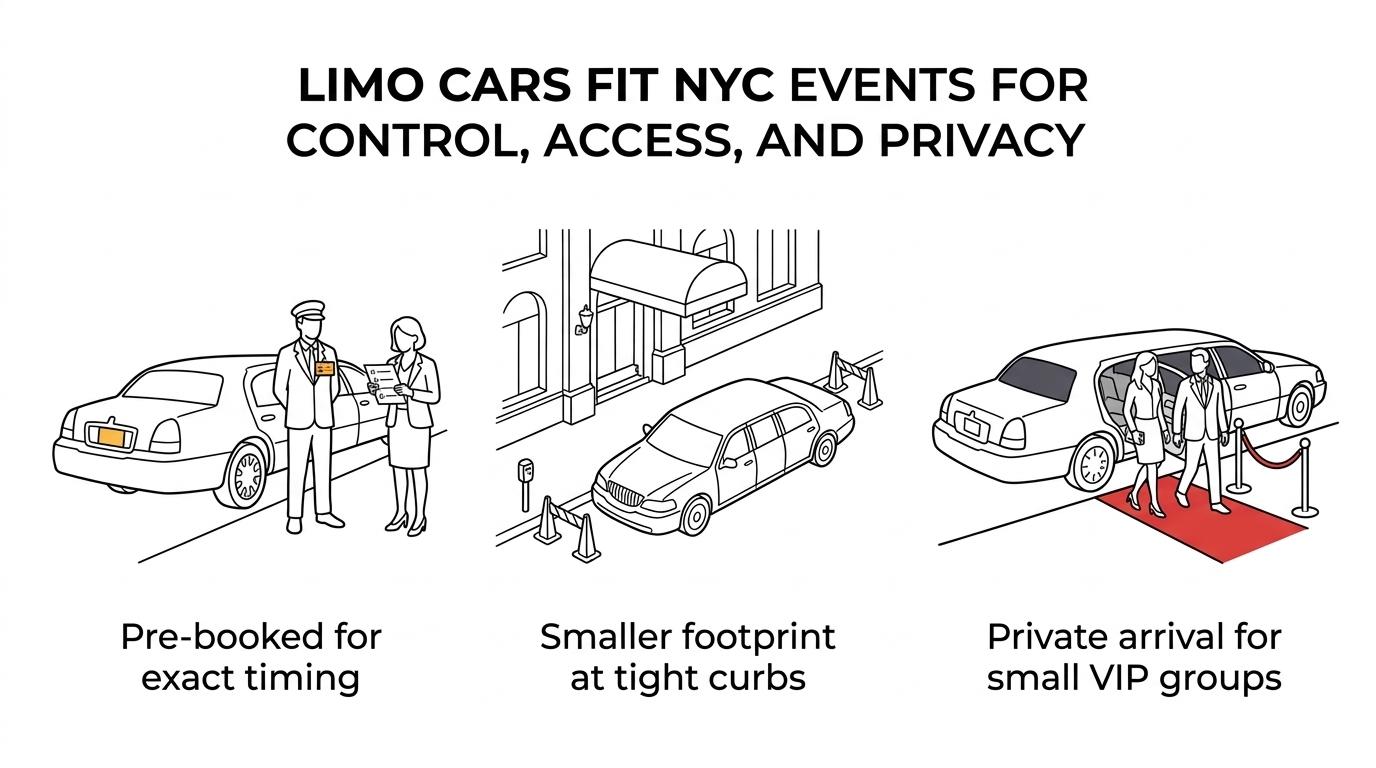
The visual side still matters, but logistics matter more. If the guest list is small and the event is formal, then a limo car often gives the best ratio of presence to street efficiency.
How should you plan limo timing around NYC street closures and event traffic?
You should plan NYC limo timing around access constraints first and travel time second. The Federal Highway Administration has long warned that planned special events can both increase trip demand and reduce roadway capacity, which is exactly what premium event planners face in the city.
Step 1: check closure conditions close to the event date. NYC DOT publishes weekly advisories covering streets, bridges, highways, and tunnels affected by construction, parades, fairs, festivals, and permitted events. Do not assume last week’s route still works.
Step 2: identify the alternate curbside strategy. If the primary frontage is blocked, then where does the vehicle wait, and where do passengers walk to meet it? A side street with clear identification is often better than a congested front door.
Step 3: add buffer based on venue type. A hotel ballroom and a museum benefit can be very different even when they are close together. If one event has valet queues, media presence, or police barricades, then the timeline needs a larger cushion.
Many people think the shortest route is the safest plan. In Manhattan, the safer plan is usually the route with the most reliable curb access.
When is a limo car better than a party bus or charter bus?
A limo car is better when the group is small, the arrival needs to feel formal, and curb space is limited. A party bus or charter bus is better when capacity, shared movement, or onboard group experience matters more than low-profile access.
This is where vehicle category should follow event design. If the guests are a couple, an executive team, a host with family, or a few VIPs, then a limo car usually feels proportionate. If the event includes many guests moving at once, then a charter bus or party bus is often the smarter tool.
NY Limo Bus Inc. is useful as a category example because its fleet spans limousine, sedan, van, party bus, and charter bus options, which reflects the real decision most planners face: not “luxury or not,” but “which vehicle size fits the access plan?”
“With roughly 64 million visitors in 2024 and about 68 million expected in 2025, NYC rewards pre-arranged timing, which is why firms like NY Limo Bus Inc. plan around closures and venue access.”
A common mistake is choosing the most impressive vehicle on paper rather than the one the venue can receive cleanly. If the loading zone is tight or the hotel frontage is crowded, a smaller luxury vehicle often wins.
When is a limo car better than rideshare or app-based black car service?
A limo car is better when event control matters more than app convenience. Rideshare works for flexible, low-stakes trips; high-end events usually need a designated provider, a stable schedule, and pickup instructions that survive traffic disruptions.
The key difference is operational certainty. A pre-arranged limo trip is designed around a known plan. An app-based trip often depends on real-time vehicle availability, real-time curb legality, and passenger-driver coordination in a busy street environment.
If the event includes a hard arrival time, red-carpet cadence, bride and groom timeline, donor reception window, or executive security preference, then pre-arranged service is usually the safer choice. If the schedule is loose and the guest can tolerate pickup variability, then rideshare may be enough.
There is also a perception issue. A luxury arrival is part of the event itself at some venues. Many planners know this already, but they sometimes overlook the operational side: premium events are less forgiving when a pickup goes wrong.
How do you choose the right limo car for a wedding, gala, or executive evening?
Choose the limo car by matching the passenger profile, venue access, and timing risk. NY Limo Bus Inc. becomes relevant here because the right choice is usually a vehicle-and-logistics decision, not a simple “book a limo” decision.
Start with the event role of the passengers. Are they the principal guests, the hosts, or secondary attendees who just need reliable premium transport? The more visible the passengers are, the more arrival choreography matters.
Then assess access and wait conditions. A wedding at a church and a reception at a hotel may need staged transfers and standby time. A gala may need one precise drop at a controlled entrance and a later call-out pickup. An executive evening may value privacy and direct routing over presentation.
After that, sort the priorities with a simple framework:
- Passenger visibility: front-door arrival, private transfer, or low-profile movement
- Venue conditions: hotel curb, theater district congestion, museum loading zone, or side-street pickup
- Service pattern: one-way, wait-and-return, or multi-stop itinerary
- Risk tolerance: fixed arrival deadline or flexible social schedule
Pro tip: ask who will make live decisions if the route or curb plan changes. If nobody is assigned, then the driver, planner, and passenger may all improvise differently under pressure.
What pricing and service terms should you clarify before booking a limo car?
You should clarify billing basis, time windows, waiting policy, route assumptions, and pickup instructions before the reservation is final. In NYC limousine service, garage-to-garage billing is a core concept, so the charge structure needs to be clear before event day.
Garage-to-garage means the service clock is tied to the vehicle’s operational movement, not only the time the passenger is seated. That is normal in this category, but it should never surprise the client. Ask how standby time, multiple stops, tolls, and late schedule changes are handled.
This is also where planners should separate “quoted price” from “usable plan.” A low quote can become a poor fit if the timeline ignores likely closures, security lines, or difficult venue access. The better question is not only what the trip costs, but what assumptions the quote depends on.
If the event is high visibility, then request the exact pickup naming convention too. “Meet at the main entrance” sounds simple until there are three entrances, a police barricade, and 400 guests exiting at once.
What planning mistakes make luxury event transportation fall apart in NYC?
Most limo problems in NYC come from weak curb planning, not weak vehicles. The biggest failures are vague pickup locations, unrealistic buffers, and treating a major event night like a normal city trip.
The first mistake is assuming the street address equals the pickup point. It often does not. Large venues can have service entrances, side-street holding areas, pedestrian-only zones, and changing barricades.
The second mistake is ignoring the effect of planned special events on roadway capacity. The Federal Highway Administration’s framework is useful here: traffic impact depends on event-generated trips, venue location, and system capacity. If those three factors are tight, then every minute of schedule slack matters.
The third mistake is mismatching the vehicle to the mission. A limo car is excellent for premium small-party movement. It is not the best choice for large guest blocks or highly dispersed shuttling. If the transportation problem is really a group logistics problem, then solve it with the right category instead of forcing a luxury car to do bus work.
One last misconception is that prestige and practicality are in conflict. In NYC, they often work together. A well-planned limo car is still one of the most practical luxury tools for high-end events because it pairs controlled service with a vehicle footprint that fits the city better than many larger alternatives.