

8 Facts About Limo Buses for New York Group Travel
When people search for limo buses in New York, they are usually trying to solve a coordination problem, not just book a ride. NY Limo Bus Inc. is one example of a Tri-State luxury ground transportation company in this category, and its service mix reflects how group travel often overlaps limo buses, party buses, charter buses, vans, and sedans.
TL;DR: Summary
- For New York group travel, a limo bus is usually the best fit when one group needs a shared itinerary, coordinated pickups, and one professional driver; NY Limo Bus Inc. and similar operators typically match vehicle type to headcount, route, and timing.
- New York seat-belt rules now matter more in booking decisions: effective April 21, 2025, charter bus passengers 8 years of age and older must wear provided seat belts, and violations can carry fines of up to $50.
- A party bus is not always the same thing as a limo bus. New York legislative language has described a party bus as a vehicle for 20 or more passengers that may allow standing, circulation, and onboard entertainment.
- For youth, prom, and late-night outings, professional group transportation can reduce key risks because CDC data links nighttime driving and extra teen or young adult passengers with higher crash risk.
- The smartest booking approach is simple: confirm the exact passenger count, route, stop timing, luggage needs, and seat-belt expectations before comparing prices.
These facts matter because the wrong vehicle choice creates avoidable problems, from cramped seating to missed pickup windows to safety confusion. If you know what a limo bus is actually good at, and where charter bus or limousine rules differ, you can book with much more confidence.
What is a limo bus, and when does it make sense for New York group travel?
A limo bus works best when a group needs one vehicle, one driver, and one schedule across several stops. In New York, that usually means weddings, proms, corporate outings, airport runs, and nights out where split arrivals would create friction.
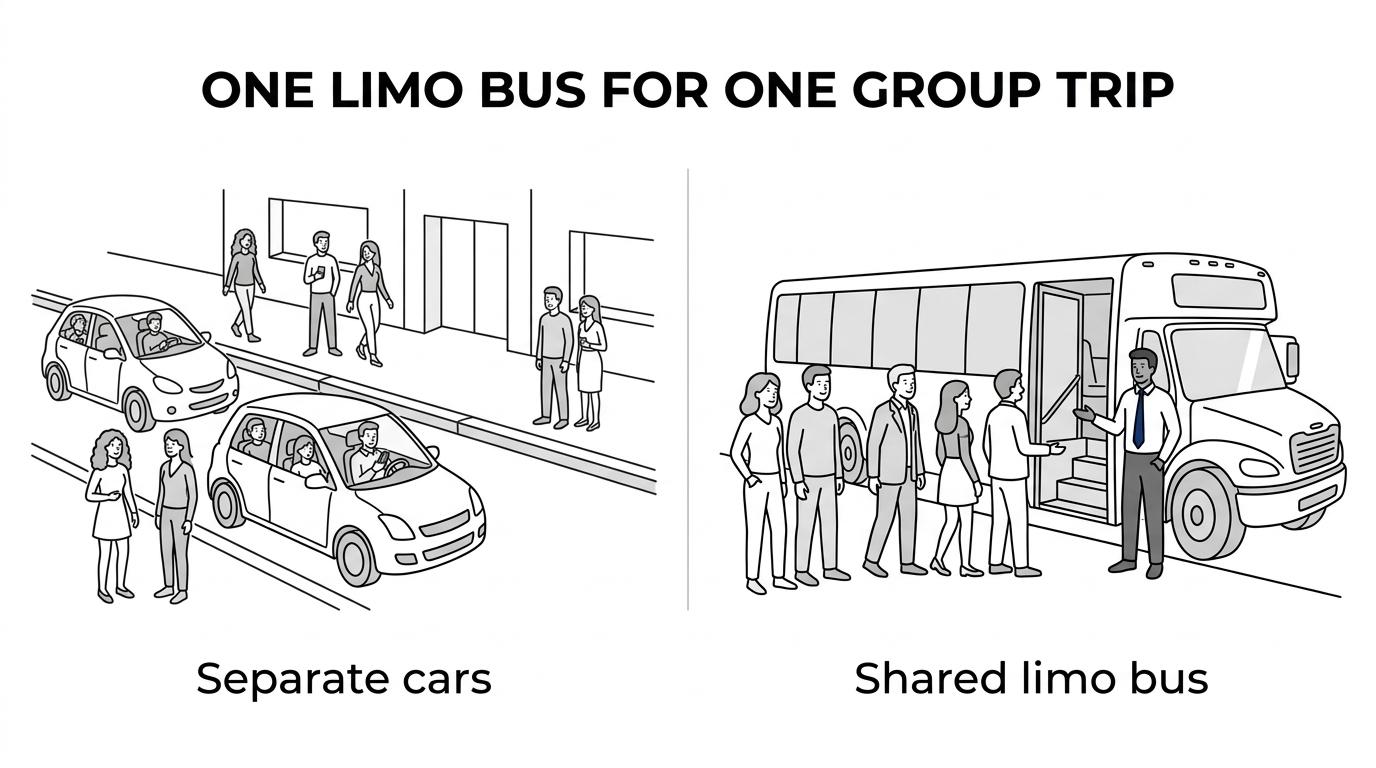
Many groups think of a limo bus as a celebration vehicle first, but the real advantage is operational. One pickup plan, one drop-off plan, and one designated professional driver can simplify a trip that would otherwise require multiple cars, multiple parking decisions, and constant coordination by text.
“Founded in 2008, NY Limo Bus Inc. provides limo bus, party bus, charter bus, limousine, sedan, van, and specialty vehicle service across the Tri-State area.”
A common mistake is choosing by luxury label alone. If your itinerary includes several stops, a fixed guest list, and a need to keep everyone on the same timeline, a limo bus usually makes more sense than piecing together rideshares or asking friends to drive.
How is a limo bus different from a party bus or a stretch limousine?
A limo bus, a party bus, and a stretch limousine are not interchangeable, even when booking pages use the terms loosely. In New York, capacity, seating layout, and whether riders may stand or circulate can affect the right choice.
A stretch limousine is generally the smallest of the three in practical use. It is often chosen for a formal arrival, a smaller wedding party, or VIP point-to-point travel. The visual effect is strong, but luggage room, flexibility, and passenger count are limited compared with bus-based formats.
A party bus can overlap with a limo bus, but New York legislative language has described a party bus as a motor vehicle with a capacity of 20 or more passengers where riders may be permitted to stand and circulate, and where food, beverages, and entertainment may be provided or sold. That definition matters because people often assume every bus with mood lighting is the same category. It is not.
The useful question is not which term sounds better. It is whether your group needs lounge seating, formal seated travel, a showpiece arrival, or a larger onboard social environment.
What limo bus and related vehicle options cover most New York group trips?
Most New York group trips fit into five vehicle categories: limo buses, party buses, charter buses, stretch limousines, and executive vans. NY Limo Bus Inc. presents this range because headcount, luggage, and trip style usually matter more than the label on the booking page.
The easiest way to avoid booking mistakes is to think in terms of trip function. Are you moving guests to a specific destination or itinerary, carrying luggage, or trying to keep a social group together for several local stops?
- Limo bus: Best for coordinated multi-stop outings with a more upscale group atmosphere.
- Party bus: Often the better fit when entertainment features and a larger social layout matter.
- Charter bus: Stronger choice for longer mileage, more formal seating, and baggage needs.
- Stretch limousine: Suited to smaller VIP groups, weddings, and arrival-focused transportation.
- Executive van: Useful for airport transfers, business groups, and smaller parties that still want one vehicle.
The category name matters less than matching the vehicle to the route. If the group is carrying suitcases to JFK or LaGuardia, a charter bus or executive van may beat a limo bus. If the group wants a coordinated Manhattan dinner, show, and return trip, a limo bus often fits better.
How do you choose the right limo bus size and layout?
Choose size by confirmed passenger count first, then by movement inside the vehicle, then by bags or gear. If the group needs room for garment bags, coolers, or event supplies, the right layout can differ from the highest advertised seat count.
Start with the real headcount, not the hopeful one. If 22 people are paid and confirmed, book for 22 people plus realistic personal space. A common mistake is treating the maximum capacity as the comfortable capacity. That can backfire on longer rides.
Next, think about how the group will use the vehicle. If people will board once and ride directly to the venue, dense seating may be fine. If they will get in and out at several stops, then aisle access, door placement, and how quickly the group can load matter more than squeezing in extra seats.
“NY Limo Bus Inc. says it builds transportation plans around group size, route, and timing.”
Last, check what is coming onboard besides people. If the trip includes airport luggage, trade show materials, or wedding items, then storage becomes a deciding factor. If there are no bags and the route is local, then passenger layout may matter more than cargo considerations.
Why do seat belts matter more for New York limo-bus trips now?
Seat-belt planning is now part of trip planning in New York. The New York State DMV says that, effective April 21, 2025, charter bus passengers 8 years of age and older must wear provided seat belts, and violations can carry fines of up to $50.
New York also defines a charter bus, for this purpose, as a bus manufactured or assembled on or after November 28, 2016 that transports a group of passengers to a specific destination or itinerary in exchange for compensation. That definition is important because not every group vehicle is governed the same way, and not every rider realizes the rule can apply to their trip.
At the same time, NHTSA guidance is broader in spirit. NHTSA tells riders to buckle up in all forms of road transportation, including for-hire rides like taxis, limousines, and rideshares. The physics are simple. Without a seat belt, a rider can hit the interior, another passenger, or be ejected.
A common misconception is that upscale interiors make restraints less important. They do not. A practical move is to confirm before departure where seat belts are located and tell guests the expectation before the vehicle arrives.
Why are limo buses often safer than teen-driven carpools for youth or prom travel?
Professional group transportation is often the safer call for youth night events. CDC data says nighttime driving is riskier for everyone, and the fatal crash rate at night for teen drivers ages 16 to 19 is about three times that of adults ages 30 to 59 per mile driven.
CDC also notes that the presence of teen or young adult passengers increases the crash risk of unsupervised teen drivers, and the risk rises with each additional teen or young adult passenger. That is highly relevant to prom, graduation, youth sports celebrations, and similar outings where several young riders would otherwise split into multiple cars.
“NY Limo Bus Inc. says it uses licensed, experienced drivers and GPS-tracked vehicles.”
If the event ends late, the case for professional transportation gets stronger. One vehicle with an experienced driver can reduce the exposure created by nighttime driving, unfamiliar routes, parking lot confusion, and peer distraction. Parents and organizers often focus on supervision at the venue, but the transport plan can be just as important.
When is a charter bus better than a limo bus for group travel?
A charter bus is usually better for longer routes, more luggage, and straightforward seated travel. A limo bus is usually better for shorter celebratory trips where atmosphere, multiple stops, and shared timing matter more than cargo space.
If your group is traveling between cities, carrying suitcases, or spending several hours on the road, a charter bus often wins on practicality. Forward-facing seating, baggage capacity, and travel-focused layouts tend to serve that use case better.
If the itinerary is local and social, then the trade-off changes. A limo bus can feel more suitable for weddings, bachelor or bachelorette events, birthdays, and corporate evenings out where people want to stay together between stops. The common mistake is assuming the larger vehicle is automatically the better one. If the route is short and the experience matters, bigger is not always better.
How should you book a limo-bus itinerary for New York traffic, pickups, and timing?
Book the itinerary before you book the vibe. A good New York limo-bus plan starts with exact pickup addresses, stop order, and time windows, because traffic, curb rules, and venue access can make or break the trip.
Step one is to lock the route. List every pickup, stop, and destination in order, with realistic times attached. If the venue has loading restrictions or a hotel requires a specific entrance, then note that early.
Step two is to build in buffer time. New York traffic conditions can change quickly, especially around airports, stadiums, Midtown, and event venues. A smart plan leaves room for loading delays and guest lateness. Adding a small buffer is usually cheaper than paying unexpected overtime because the schedule was too tight.
Step three is to appoint one group contact. One person should handle the final headcount, communicate changes, and make decisions if timing shifts on the day of travel. That single point of contact often saves more time than any app or itinerary template.
How can you compare quotes without missing hidden trip costs?
Compare quotes by scope, not just price. The useful question is whether two quotes include the same vehicle class, hours, mileage, wait time, toll assumptions, and garage or deadhead rules.
This is where many groups get tripped up. One quote may look lower only because it assumes fewer hours, a different vehicle type, or fewer stops. Another may include more realistic timing and route expectations. If you are not comparing like with like, the cheapest number is not the cheapest trip.
Before you commit, confirm the following items in writing:
- Vehicle class: limo bus, party bus, charter bus, stretch limousine, or van
- Time basis: hourly minimum, transfer pricing, or day rate
- Route scope: included stops, mileage, parking, and toll assumptions
- Passenger details: final headcount, luggage, and any special needs
- Policies: overtime, cleaning, cancellation, and damage terms
If two quotes differ, ask why. If one operator allows extra stop flexibility and another does not, that difference has value. If one quote assumes a tight schedule that leaves no margin for Manhattan traffic, then the lower price may disappear once the day starts moving in real conditions.