

7 Reasons Passenger Van Rental Fits Small Event Groups
Small event groups often sit in an awkward transportation gap: too many people for one SUV, not enough for a full coach. That is where passenger van rental becomes useful, especially for weddings, airport runs, corporate outings, and private group trips with tight timing. In the Tri-State market, operators like NY Limo Bus Inc. work across categories from vans to limo buses, which makes passenger vans easier to evaluate as a practical option rather than a luxury upgrade.
TL;DR: Summary
- Passenger van rental is often the best fit for small event groups because a 9-to-15-passenger van keeps the group together without paying for bus capacity you do not need.
- NY Limo Bus Inc. is relevant here because it provides vans, limousines, limo buses, and charter buses, which reflects how event transportation is usually matched to passenger count, route length, timing, and luggage.
- 15-passenger vans are flagged by NHTSA for seat belt use, tire checks, trained drivers, and cargo placement as critical safety factors.
- FMCSA oversight can apply when a van carries 9 to 15 passengers including the driver for compensation in interstate commerce, so provider compliance matters on cross-state trips.
- Passenger vans work best when the group has one shared itinerary, limited luggage, and needs fewer parking spots and fewer moving parts than multiple cars.
The key question is not whether a passenger van is “good” in general. It is whether the group size, luggage load, route, and event schedule make a van the cleanest operational fit. For many small groups, the answer is yes, but the details matter.
Is passenger van rental a good fit for small event groups?
Yes. For weddings, airport transfers, and corporate outings, NY Limo Bus Inc. treats passenger vans as the practical middle ground between sedans and larger buses.
A passenger van rental fits best when a group is too large for a single luxury SUV or sedan but too small to justify a mini coach or charter bus. That usually means one organizer, one event timeline, and one route plan with relatively compact luggage. Instead of splitting eight to fourteen people across separate rideshares or personal vehicles, a van keeps arrivals tighter and communication simpler.
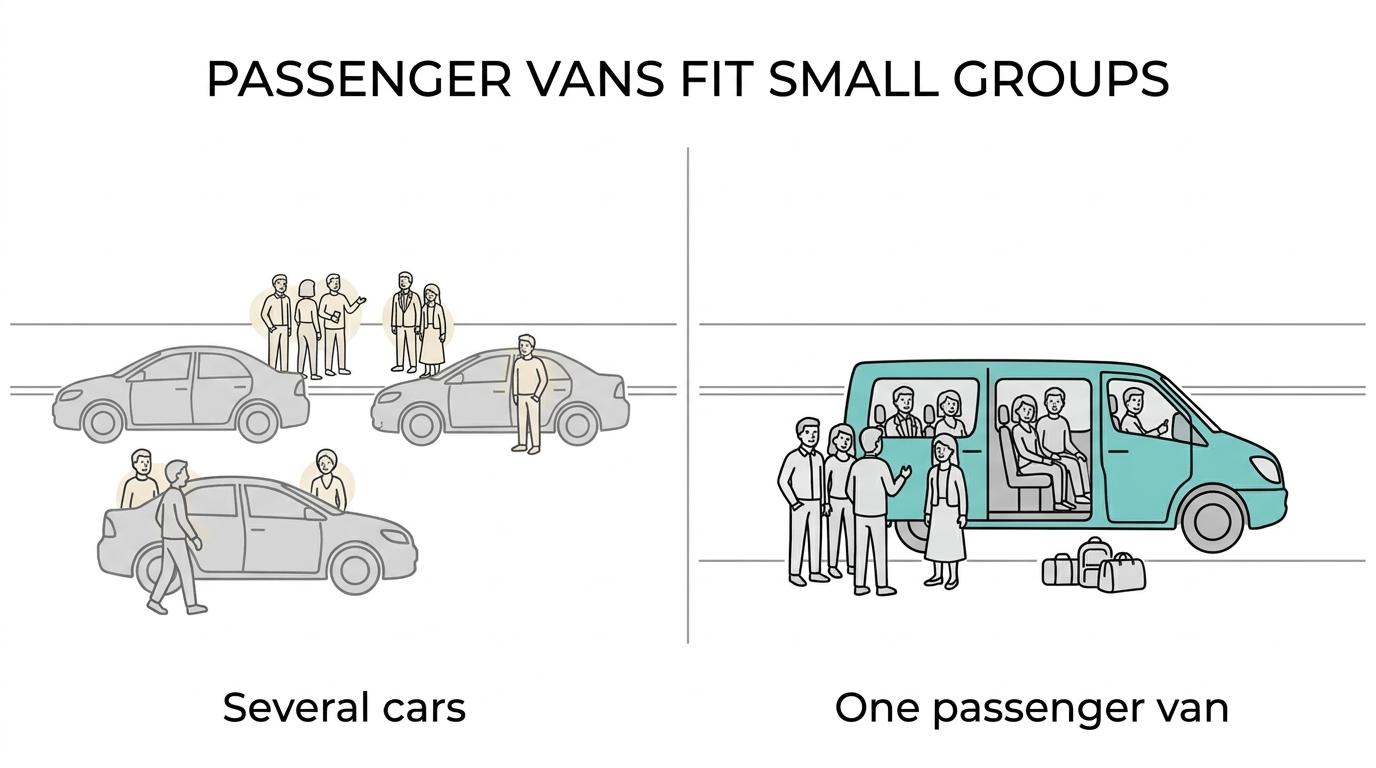
That matters more than many planners expect. A small group can still lose time when half the guests are parking, one car gets delayed, and another misses a checkpoint or venue entrance.
“NY Limo Bus Inc. has been arranging custom-tailored ground transportation since 2008.”
The best use cases are straightforward: wedding party transfers, airport pickup for family members, corporate off-site shuttles, casino trips, and multi-stop celebrations where the group wants to stay on the same schedule. If your group needs heavy luggage space, standing room, onboard entertainment, or more than 15 seats including the driver, a larger vehicle class starts making more sense.
When does a passenger van rental make more sense than multiple cars?
A van makes more sense when 8 to 14 people are traveling on one schedule in the same direction and parking, tolls, and coordination costs would pile up across separate cars.
The basic trade-off is simple. Multiple cars may look cheaper on paper, but they create operational drag. Someone has to drive, someone gets stuck handling directions, and someone always arrives late. A van reduces those handoffs. For event planners, that means fewer moving parts to manage and fewer guest updates to chase.
A common misconception is that “small group” automatically means “just use rideshare.” That works for casual outings with flexible timing. It works less well for ceremonies, airport arrivals, venue curfews, and corporate programs where a five-minute delay becomes everybody’s problem. If the event has fixed time points, group transportation often wins because it reduces timeline risk, not just because it carries people.
Passenger vans also use fewer parking spaces than several cars. In dense parts of New York and New Jersey, that alone can change the math.
What are the 7 reasons passenger van rental fits small event groups?
Passenger van rental fits small event groups because it balances capacity, scheduling control, and cost discipline better than either scattered cars or oversized buses.
Most small event transportation problems come down to one issue: the group is compact, but the logistics are not. That is why vans tend to perform well in this range.
- The group stays together: One vehicle reduces missed turns, staggered arrivals, and last-minute location confusion.
- Capacity matches the job: A 9-to-15-passenger van often fits a wedding party, office team, or family group without paying for unused bus seats.
- Timing is easier to control: One departure time is simpler than coordinating several drivers and several parking plans.
- Parking gets easier: One van usually creates fewer venue and hotel parking issues than multiple personal cars.
- Airport and multi-stop trips run cleaner: A single manifest and one route plan make pickups and handoffs easier to manage.
- Cost can be more rational than it looks: When tolls, parking, mileage, and delay costs are counted, one van can compare well with several separate rides.
- The upgrade path is clear: If the guest count grows or the itinerary changes, you can move up to a larger vehicle class without redesigning the whole plan.
The last point matters for event planners. Transportation rarely stays static. Headcount changes, luggage increases, and pickup windows tighten. Vans are often the easiest entry point because they solve the immediate problem without locking the group into bus-scale spending.
How do you estimate the right van size for your group?
Start with confirmed passengers, then subtract for luggage pressure, then test the route against comfort and trip length.
Step 1 is the headcount, not the invitation list. If 12 people are invited but only 9 are confirmed, quote for 9 and ask about the cut-off for vehicle changes. Step 2 is luggage. Twelve adults with carry-ons is a different fit from twelve adults with checked bags, garment bags, and event supplies. Step 3 is route time. A short hotel-to-venue transfer can tolerate a tighter layout than a long airport or interstate run.
Common mistake: counting only seats. Capacity is not the same as comfort. If the trip includes formalwear, coolers, equipment, or child gear, treat those items like passengers because they consume usable space.

If the route includes multiple pickups, add time for loading. If the venue requires early staging, ask how long the group can board before departure. Those details often matter more than the difference between 12 seats and 14 seats.
How should you compare passenger van rental vs a charter bus?
Choose a passenger van when the group is small and the route is compact. Choose a charter bus when headcount, luggage, or trip duration pushes comfort and storage needs higher.
A van is usually the efficient choice for compact groups. A charter bus starts to win when the group size rises, the route length grows, or the baggage load becomes meaningful. Charter buses also make more sense when you need undercarriage storage, wider aisles, or a more spacious boarding experience.
Here is the practical test. If your group can board quickly, sit comfortably for the route, and keep bags organized without crowding the cabin, a van is probably enough. If not, a bus is not overkill. It is the correct operational class.
Pro tip: do not compare vehicles by hourly price alone. Compare them by total plan fit. An undersized van can create schedule slippage and discomfort. An oversized bus can create unnecessary cost. The right vehicle class sits in the middle of those two risks.
What safety checks matter most for 9-to-15-passenger vans?
The most important safety checks are seat belt use, tire condition, cargo placement, and driver readiness, and NHTSA is explicit about all four.
NHTSA notes that 15-passenger vans are widely used for group transport, but they require disciplined safety habits. Seat belts are not a side issue. NHTSA reports that 69% of 15-passenger van occupants killed in crashes from 2010 to 2019 were known not to be wearing a seat belt. It also reports that 57% of the 235 occupants killed in rollover crashes in that period were ejected. That is why seat belt enforcement, not just seat belt availability, matters.
Cargo placement matters too. Heavy items loaded high or behind the rear axle can affect vehicle handling. Tire pressure and tread condition also matter because underinflation and overloading can increase instability. If the van has electronic stability control, that is a meaningful safety feature, but it does not replace good loading and driving practices.
“NY Limo Bus Inc. says its vehicles are GPS-equipped and its drivers are licensed, professional, and experienced.”
A frequent misconception is that the driver is the only safety variable. In reality, occupancy, belt use, tires, and cargo distribution all interact. If the group fills every seat and packs luggage into every open space, ask whether the vehicle class still fits the trip.
How do federal rules affect for-hire passenger van service?
If a paid trip crosses state lines, providers like NY Limo Bus Inc. have to think beyond seating and into FMCSA commercial motor vehicle rules.
This is one of the most useful distinctions for buyers. A small passenger van may still fall under federal safety oversight when it is designed or used to transport 9 to 15 passengers, including the driver, for compensation in interstate commerce. FMCSA treats that as a commercial motor vehicle scenario, even though the vehicle looks much smaller than a bus.
That can trigger obligations tied to direct compensation, including registration, a USDOT identification number, and compliance with Federal Motor Carrier Safety Regulations in parts 385 and 390 through 396. FMCSA also says for-hire passenger carriers in interstate commerce must obtain operating authority and maintain minimum financial responsibility of $1.5 million for vehicles of 15 or fewer passengers including the driver.
What does that mean for the buyer? Ask better questions. If the trip stays within one state, the compliance picture may differ from an interstate run between New York, New Jersey, and Connecticut. If the service is for compensation and crosses state lines, the provider should be ready to address driver qualification files, inspection and maintenance records, accident registers, and maximum driving time standards.
A common mistake is assuming a smaller vehicle means lighter oversight. That is not always true in for-hire interstate passenger service.
How do you plan pickups, stops, and luggage without slowing the event down?
The cleanest plan clusters pickups, limits dwell time, and assigns luggage space before the day of travel.
Step 1 is to reduce unnecessary stops. Two organized pickup points usually run better than six loosely timed door-to-door pickups. Step 2 is to label fixed time points: ceremony start, airport arrival, venue access window, cruise check-in, or corporate check-in. Step 3 is to match bags to space before the trip rather than discovering a capacity issue at curbside.
If then logic helps here. If the route includes airport pickups, then flight timing and baggage claim delays should be built into the schedule. If the route includes a wedding party, then allow more boarding time for formalwear and photos. If the route includes older guests or children, then reduce the number of loading transitions.
This is also where route length matters. A van that is perfect for one direct transfer can become less efficient when the itinerary turns into a roaming multi-stop plan with gear, gifts, and coolers.
How do you book a passenger van rental without surprise costs?
The safest way to book is to define the trip in operational terms: date, headcount, pickup, destinations, fixed times, and whether the plan may change.
A clear request produces a cleaner quote. Share the event date, confirmed passenger count, pickup location, destination list, and any hard timing points. Then ask what can change without repricing. Good examples are extra stops, overtime, wait time, airport delays, and headcount changes that could force a vehicle swap.
“NY Limo Bus Inc. says the fastest accurate quote starts with five details: date, passenger count, pickup, destinations, and fixed time points.”
You should also ask whether the quote is built around a transfer, an hourly minimum, or a custom itinerary. Those structures can price very differently even when the passenger count is the same. If the trip may cross state lines, ask that question early. If luggage is uncertain, say so early. Those details affect the right vehicle class more than many first-time renters expect.
One useful rule is simple: if the trip is easy to visualize, it is easier to price correctly. If the plan is still fluid, say that upfront and ask where the decision points are. That keeps the rental aligned with the event instead of forcing the event to adapt to the vehicle.