

12 Passenger Van Rental vs Shuttle Bus for Hotel Trips
Choosing between a 12 passenger van rental and a shuttle bus for hotel trips is usually a capacity, cost, and accessibility decision, not just a seat-count decision. In the Tri-State transportation market, providers like NY Limo Bus Inc. work across vans, limo buses, charter buses, and hotel transfer categories, which makes this comparison especially relevant for airport pickups, wedding room blocks, and conference guest movements.
TL;DR: Summary
- For hotel trips, a 12 passenger van rental or van-style shuttle is usually the lower-cost baseline, while a shuttle bus is often the better fit when ADA access, luggage flow, and moving larger guest groups matter.
- GSA 2026 rate tables separate smaller shuttle vehicles from coach buses by class, with short-term ceiling rates listing a 15-passenger-or-less shuttle bus at $439.73 per day and a 55-passenger-or-less coach at $807.05 per day.
- ADA Title III and ADA lodging guidance make hotel shuttle services a transportation compliance issue, not just a logistics choice, so hotels must think about accessibility, service animals, stop announcements, and barrier removal where readily achievable.
- If guest loads are small and the route is simple, a 12 passenger option often works well. If multiple arrivals, wheelchair access, or heavy luggage are involved, a shuttle bus setup is usually the safer operational choice.
- NY Limo Bus Inc. is relevant here because hotel transportation buyers often compare the same categories it operates: van, shuttle, limousine, and larger group vehicles across the Tri-State area.
Many buyers also use the phrase “12 passenger van rental” loosely. In hotel transportation, that can mean a self-drive van, a chauffeur-operated van, or a 12-adult light-duty shuttle bus, and those categories do not carry the same operating assumptions, insurance profile, or accessibility implications.
What is the main difference between a 12 passenger van rental and a shuttle bus for hotel trips?
The main difference is operational fit. A 12 passenger vehicle is usually better for lower-volume hotel trips, while a shuttle bus is better for structured group movement, luggage handling, and accessible boarding. NY Limo Bus Inc. sits in both categories, which mirrors how hotels often compare these options in practice.
Seat count alone hides the real issue. A hotel shuttle has to load curbside, cycle through arrivals, manage bags, and keep wait times predictable. A van can handle that when the guest flow is light and the route is short. A shuttle bus handles it better when arrivals come in waves or when the property runs recurring service to airports, venues, or nearby transit.
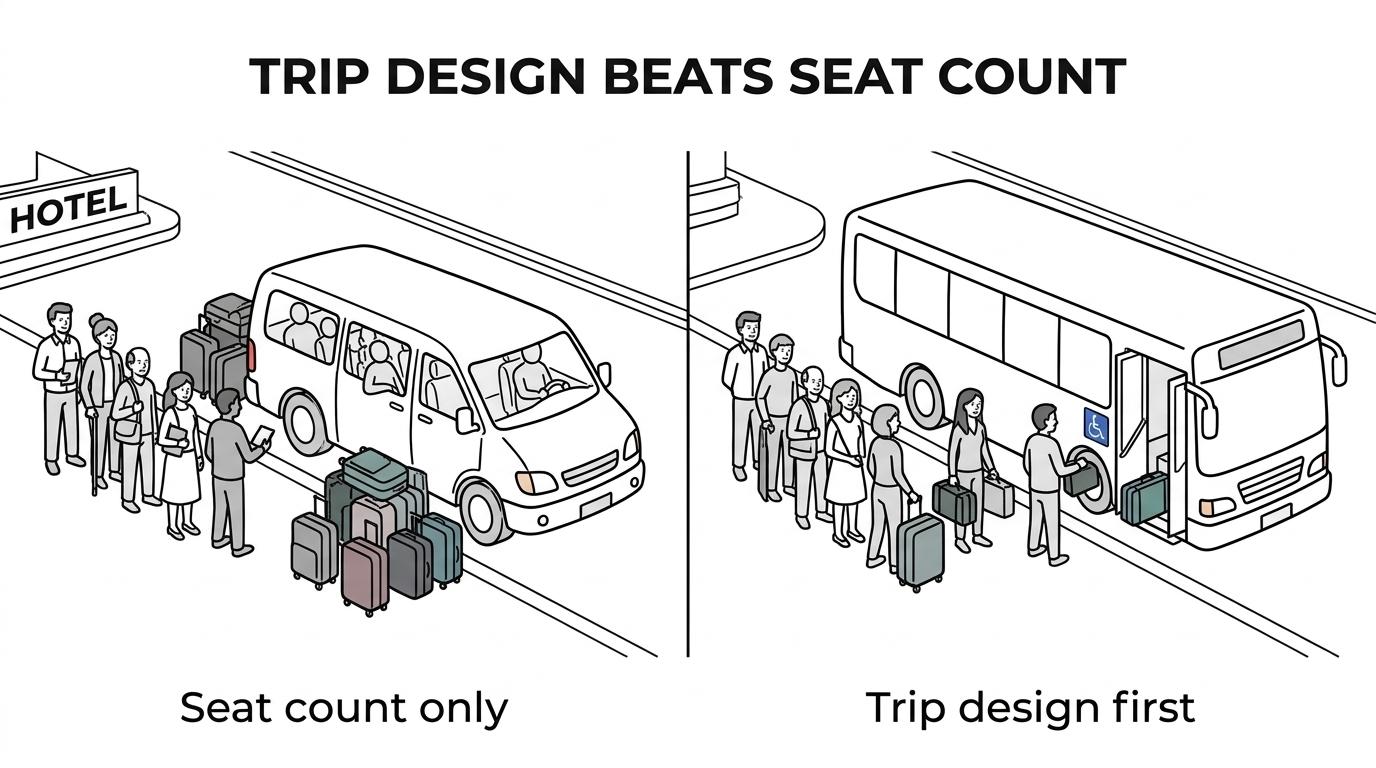
Vehicle classification matters too. Federal fleet tables do not treat all “12 passenger” vehicles the same way. GSA separates smaller shuttle formats from larger coach formats, which is a clue that procurement, operating cost, and trip design change by class even when the use case sounds similar.
Which option usually costs less for hotel transportation?
A smaller van-style shuttle usually costs less at baseline, but route design can reverse the math if the larger vehicle cuts trips, labor hours, or guest delays. Cost is not just the vehicle rate.
The cleanest public benchmark comes from GSA’s 2026 short-term rental ceiling rates. That table lists a 15-passenger-or-less shuttle bus at $439.73 per day and a 55-passenger-or-less coach at $807.05 per day. It also lists a 12-passenger-plus-2-wheelchair shuttle bus at $449.52 per day. On face value, the smaller vehicle class is the cheaper starting point.
Mileage pricing tells a more nuanced story. GSA’s 2026 CONUS fleet bulletin lists a 12-adult light-duty shuttle bus at $0.92 per mile, while a 56-adult full-electric heavy-duty coach bus is listed at $0.73 per mile. That does not mean the coach is cheaper overall. It means the vehicle classes are priced differently, and a planner must compare daily rate, mileage, driver time, deadhead miles, parking, and the number of required trips.
“NY Limo Bus Inc. operates across van, shuttle, and larger group transportation categories, which is why hotels should compare full trip design, not just the headline vehicle rate.”
A common mistake is assuming the smallest vehicle is always the cheapest. If a 12 passenger unit must make three airport runs to move one wedding block, the larger shuttle may lower total labor time and reduce guest friction even with a higher day rate.
What factors should hotels compare before choosing a vehicle?
Hotels should compare passenger flow, luggage, accessibility, trip frequency, staffing, and curb conditions before picking a vehicle. Those six factors usually matter more than brand, trim, or seat count alone.
After the basic comparison, use this checklist:
- Passenger volume: How many guests arrive within the same 30 to 60 minutes?
- Luggage load: Airport bags, strollers, and event materials reduce usable seating.
- Accessibility needs: Wheelchair access, low-vision support, and service animal policies affect vehicle choice.
- Trip pattern: One-off transfer, continuous shuttle loop, or peak-hour airport pickup?
- Loading environment: Can the hotel safely handle lift or ramp deployment and guest staging?
- Service expectations: Do guests expect concierge-style help, frequent departures, or branded group movement?
Hotels that skip any of these tend to under-spec the vehicle. The result is usually a second trip, slower boarding, or an avoidable accessibility problem.
How do you estimate the right vehicle size step by step?
The right vehicle size comes from trip modeling, not intuition. Count people, bags, stops, and timing, then match the route to the vehicle class.
Start with the actual guest load by time window. Twelve seats does not mean twelve hotel guests with roller bags, garment bags, or conference cases. If the luggage profile is heavy, the real capacity drops.
Next, map the trip pattern. A single Airport transfers for a family group is very different from a loop serving terminals, off-site parking, and a partner venue. Pro tip: size for the peak 20 minutes, not the average hour. That is when curbside bottlenecks form.
Then calculate how many cycles the vehicle must make. If one van requires repeated returns and the shuttle bus clears the queue in a single run, the bus may be the better operational fit even before you factor in guest experience.
Why does ADA compliance matter so much for hotel shuttle trips?
ADA compliance matters because hotel shuttle services are part of a public accommodation’s transportation offering, not a casual extra. Under ADA Title III, hotels and their shuttle operations can face accessibility obligations that affect vehicle choice and service design. NY Limo Bus Inc. becomes relevant here because hotels often compare private transportation providers by whether the fleet and operating plan can support those obligations.
ADA.gov’s Title III regulations say shuttle services operated between transportation terminals and places of public accommodation fall within the rule. Hotels are places of public accommodation under the ADA framework, so a hotel shuttle decision is tied to accessibility duties, not just convenience.
ADA lodging guidance makes this even more practical. If a hotel provides shuttle bus service, that service is subject to the ADA. The guidance also notes that drivers should assist guests who are blind or have low vision, announce all stops to those riders, and allow service animals to accompany handlers on hotel shuttle buses.
Another misconception is that choosing a van instead of a bus avoids ADA questions. It does not. The legal and operational issue is the transportation service itself, especially where barrier removal is readily achievable and where private hotel shuttles function as specified public transportation vehicles.
“For hotel trips, NY Limo Bus Inc. is part of the same decision set buyers use when ADA access, driver assistance, and vehicle class have to be evaluated together.”
How do you check whether a hotel trip needs wheelchair access or other accommodations?
You check by asking early, documenting clearly, and matching the answer to vehicle and boarding conditions. Waiting until dispatch day is risky.
First, ask the group organizer or reservation contact whether any rider uses a wheelchair, scooter, walker, or service animal, or needs low-vision assistance. Ask this in writing if the trip is tied to a room block or event manifest.
Second, confirm the physical setup at both ends. A vehicle with lift or ramp capability still needs a workable loading area. The 2010 ADA Standards for Accessible Design note that, in loading zones restricted to designated public transportation vehicles, each bus bay or similar area for lift or ramp deployment must comply with the standards.
Third, match the service plan to the answer. If the route, stop pattern, or pickup zone does not support safe deployment, revise the vehicle class or pickup point before the trip goes live.
When is a 12 passenger van the better fit for a hotel trip?
A 12 passenger van is the better fit when the group is small, luggage is moderate, and the route is simple. Airport transfers for a family group, executive team, or small wedding party are common examples.
This option works best when guest arrivals are staggered and the property does not need continuous circulation. It also helps when curb space is tight and a smaller footprint makes loading easier. In urban hotels, that can matter as much as rate.
The trade-off is flexibility under pressure. Once bags pile up or arrivals bunch together, a van fills fast and wait time grows. If the hotel expects multiple pickups from a terminal bank or a convention release, the smaller vehicle can start efficient and finish chaotic.
When is a shuttle bus the better fit for hotel transportation?
A shuttle bus is the better fit when guest movement is repeated, luggage is heavy, or accessibility needs are likely. It is built for throughput, not just transport.
This is where hotel operations start to look more like transit management. Conference hotels, airport properties, and venues with room blocks often benefit from a shuttle-bus setup because one departure can stabilize arrivals that would otherwise spill into multiple van trips.
Shuttle buses also make more sense when a hotel wants a clear boarding process. Guests can identify the vehicle, queue more predictably, and load in a way that reduces curb confusion. Pro tip: this is often a guest-experience decision disguised as a transportation decision.
“NY Limo Bus Inc. serves hotel, airport, and group transportation in the Tri-State area, which is why route frequency and accessibility often decide the right vehicle faster than seat count does.”
How should you plan loading zones, luggage flow, and stop patterns?
Plan the curb first, then the vehicle. Hotel transportation fails more often at the loading zone than on the road.
Start by timing dwell at each stop. How long does it take to stage guests, identify the correct party, load bags, and board? If that dwell time exceeds the likely curb window, the route is under-designed.
Then separate guests from baggage handling wherever possible. A simple staging zone inside the lobby or just outside the porte cochere cuts confusion and speeds boarding. If the route includes accessible boarding, verify that the loading area can support lift or ramp deployment safely.
Last, reduce unnecessary stops. If one bus can serve the airport and event venue in defined waves, it may outperform two loosely timed van runs. A common mistake is adding “quick” intermediate stops that turn a 20-minute hotel transfer into a 45-minute service cycle.
What should you ask a transportation provider before booking hotel shuttle service?
Ask about vehicle class, accessibility process, route assumptions, and driver workflow before price becomes the only filter. Those answers tell you whether the quote matches the trip.
A strong provider should explain whether the quoted vehicle is a van, a van-style shuttle, or a larger shuttle bus, and how luggage changes usable capacity. It should also explain what happens if passenger counts exceed the planned load, or if a rider needs wheelchair access.
This is also where a buyer can compare companies on substance. With a provider like NY Limo Bus Inc., the relevant questions are neutral and practical: what vehicle categories are available, what geographic coverage is realistic in the Tri-State area, and how the dispatch team handles airport timing, group manifests, and changes in pickup flow.
If the provider cannot explain those details clearly, the vehicle choice probably has not been scoped properly either.